07 May 2007

Honor Thy Bronze

A couple of evenings ago I went out to Moscow's Victory Park, the vast complex opened in 1995 to commemorate the Soviet victory over Nazi Germany. While some find the place aesthetically unappetizing, I find it to be both moving and a peaceful place to walk at sunset when the tall bronze obelisk casts an endless shadow across the land.

The weight of history is palpable during the long walk toward the memorial. One by one I pass the engraved stones, each one marking a year of that terrible war: 1941...1942...1943...1944...1945. All in all the walk takes at least 10 minutes at an appropriately reverent pace. That's how large the complex is.


The effect is intensified when darkness falls and the fountains lining the park are lit in red, as if the blood of the tens of millions who died in the war has sprung forth from the soil of the motherland they died defending.


I am immersed in silent reflection as I walk through the park at dusk, trying to grasp the immense weight of this event in Russian and world history. I'm startled by a sudden noise benind me: CLACK CLACK CLACK THUD!

It is the sound of the ubiquitous skateboarders, rollerbladers, and bike riders as they practice their tricks in, around, among, and on the memorial park. In a vast complex of marble steps, railings, benches, and other intriguing surfaces in stone and bronze, the opportunities for tricks are equally immense. They go careening off steps, their boards clattering noisily when they hit the ground. They race along the marble edge of the fountains to see how much air they can get when they reach the end. And they weave in and out of the columns under the museum seeing how fast they can take the slolam.

Indeed, Victory Park has become a mecca for these wheeled teenagers, a veritable playground for boarders, bikers, and skaters. Which is why Victory Park is starting to lose its weighty esseence for me. It's hard to be moved by a war memorial when kids are using it as a piece of entertainment equipment.

The worst example I saw, the most painful and shameful, took place several weeks ago when I was at the park. Behind the museum is a massive bronze installation by the sculptor that Muscovites love to hate, Zurab Tsereteli. This monument to the victims of the Holocaust is titled "Tragedy of the Nations" and depicts emaciated figures either melting into or rising out of the earth, their personal belongings scattered in piles around them. In fact, unlike many of Tsereteli's works, this one is quite inspired.

The monument is layed out in a large semicircle, one side of which are the massive human figures, the other side a curved bronze wall, curling over the marble base as if it were a wave about to break. As I approached the monument, I saw a young guy on a trick bike racing along the curve of the bronze wall to gain speed before launching off the marble steps leading to the monument.

That's right, you heard me: a kid doing bike tricks off a Holocaust memorial.

Originally this post was going to be about the tragedy of memory lost. The tragedy of the old generations dying off and the younger generations never knowing, remembering, or appreciating the massive price paid in human lives to defeat one of the greatest threats to humanity in history. It was going to be a post about how, despite the horrors committed at home by the Soviet state before, during, and after the war, this was something that Russians should remember and honor eternally for their sacrifice was immense. And it was going to be a post about how the memorial to that sacrifice deserves more respect and better treatment than serving as a skating park for a bunch of punks.

And I suppose that that is still part of the motivation for me writing this. But as I was walking through Victory Park to the clatter of flipped skateboards, my thoughts kept returning to another bronze war memorial that's been in the spotlight recently.

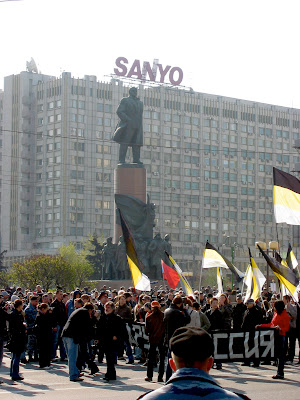
I'm referring, of course, to the Bronze Soldier memorial built by the Soviets in the center of Tallinn, Estonia and recently relocated to a cemetery on the outskirts of town. Many of you reading this are familiar with the controversial decision and the uproar it has caused. For those of you who have not followed the story, the Estonian government's decision has sparked outrage among the Russian population living in Estonia as well as among Russians in Russia and the Russian government itself.

Of course, there are two sides to every story. The Estonian population sees the monument as a symbol of the 50-year occupation of their country by Soviet forces that began at the start of the war. The Russian population holds the monument as a sacred memorial to the sacrifices made by brave soldiers in defeating fascism. The results have been disturbing: rioting and looting in Tallinn, demonstrations in Russia protesting the "fascist" actions of the Estonian government, attacks on the Estonian embassy and ambassador in Moscow, and calls in the Federation Council to sever diplomatic ties with Estonia in protest to the relocation of the Bronze Soldier.

With the memory of the Bronze Soldier fresh in my mind, I couldn't but help wonder why a country that becomes so enraged when another country relocates a war memorial doesn't seem to mind when its own war memorial is disrespected every day by teens on skateboards. At best it seems like hypocrisy. At worst it looks like cynicism as nationalist elements in Russia utilize these events to advance their political goals.

Of course, there are many important distinctions that need to be made here. First, the Bronze Soldier in Tallinn was built over the remains of war dead, whereas Victory Park was never the scene of any military action and thus lacks the degree of holiness imparted by the dead. But, the Estonian government seems to be making every effort to treat the remains with care in relocating them to the cemetery.

Second, I realize that the people doing tricks at Victory Park are not the same people protesting the events in Tallinn. But if the Нашисты are indignant enough to demonstrate at the Estonian embassy for days on end, then whey aren't they out at Victory Park guarding the honor of their own war memorial? I find bikers on Holocaust memorials offensive. Don't they? Shouldn't they be out there patrolling the grounds and trying to impose a little order in memory of those who died for the motherland? Or, if they believe in the rights of individuals to do what they want in public parks, shouldn't they also understand the right of sovereign nations to make their own decisions?

In the very least they should know to honor their own bronze before raising arms over the bronze of others.

04 May 2007

Lenins 'N Things

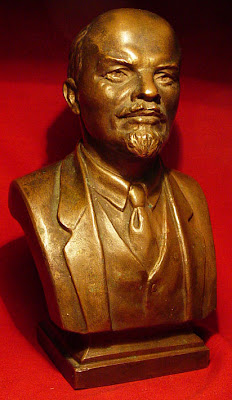
Most of you by this point are aware of my somewhat unusual hobby of collecting busts and statues of Lenin. If this is news to you, then you haven't been paying very close attention, have you? It's OK, I don't blame you. Or, if you're a newcomer and need to catch up, you can read all about my hobby HERE

Nonetheless, as promised (and at the constant prodding of Comrade Tornadochka), I've finally put up a photo gallery with all the Lenins. Enjoy if you dare. Here's my favorite one:


While we're on the subject of Russian leaders, I was visiting with the 95 year-old woman who lives next door a couple nights ago. I decided to ask her a provocative question:

"Vera Ivanovna, tell me who, in your opinion, is the best leader Russia has ever had. It can be a Tsar, a Soviet leader, a contemporary leader. Who's the best?"

Of course, I was fishing for the expected answer: longing for the good ol' days, maybe she'd answer Brezhnev. Or maybe she's a true "order and stability" comrade and would answer Stalin. But then again, maybe a liberal streak in her would answer with Khrushchev. Or maybe she would reach farther back into the pantheon of Russian Tsars to select someone like Alexander II (who freed the serfs) or Peter the Great.

That's what I expected. Her answer, however, was quite unexpected:

"You know, we really haven't had any good leaders to speak of."

And that was that.

01 May 2007

May Day Part 2: The Rest

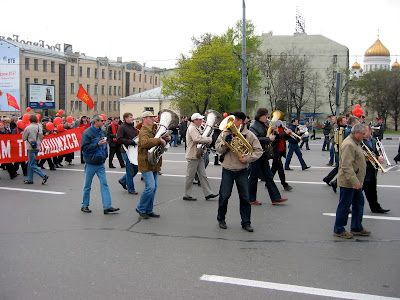
After leaving the Comrades at Sverdlov (temporarily renamed Teatralnaya) Square, I headed up the empty street to the Lubyanka, where they're preparing decorations for the May 9 (Victory Day) celebrations.


There I encountered rally held by the "Patriots of Russia" Party, a minor left-wing party formed when its leader, Gennady Semigin split from the Communist Party.


Though they may have been born out of the communists, the Patriots of Russia have an eye on the younger generation, having a rock band perform patriotic-themed songs at the rally. While all age groups were represented, it was a younger crowd than the Communists down the street, and even the babushkas present were tapping their toes to the music.


From there I hopped on the metro and headed over to Pushkin Square, where there was sure to be some action. I was not disappointed, as I popped out right in front of LDPR's rally. I'm not sure blue is Pushkin's color, though. The banner says, "LDPR - We're for the poor! We're for Russians!"


This was a much younger crowd and a larger one than I had just seen at Lubyanka.


They went wild when LDPR leader and political renegade Vladimir Zhirinovsky gave his speech:


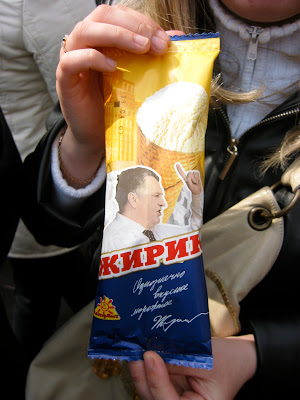
But they went even wilder (not joking) when they passed out Zhirinovsky's own line of ice cream (also not joking):


Like the Patriots, LDPR is targeting a younger crowd, resulting in the appearance of a guy rapping about how great Russians are, using the word for ethnic Russians (русский), not the word for citizens of the Russian Federation (российский). Not a big surprise, as the LDPR is on the ultranationalist end of the spectrum.


Not impressed with his rapping skills or his message, I ditched the rapper and worked my way back to the street where I got some photos of Zhirinovsky leaving.


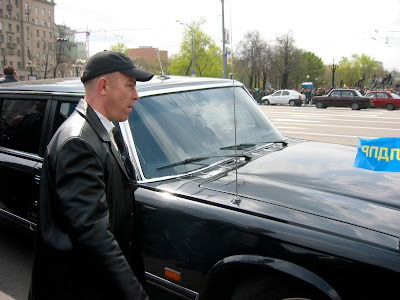
He sped off down the street in his classic Soviet-era ZIL limousine. It has to be some sort of political statement, as his retinue followed in a much nicer modern (western-made) limo.


Then I headed across Tverskaya Ulitsa where there was a very small rally held by the Eurasia Youth Union, the youth wing of the minor Eurasia Party.

Their rally was focused on protesting the recent move by the Estonian government to remove the Soviet-era WWII memorial ("The Bronze Soldier") from central Tallinn, relocating it to a cemetery on the outskirts of the city. The move has infuriated Russians living in Estonia and produced an outcry from Russia as well. The upper house of the Russian parliament recently passed a nonbinding measure calling for the suspension of diplomatic relations with Estonia in response. Even worse has been the street protests, violence, and looting in Tallinn as a result.

Their speeches were heavily nationalistic, calling for action against the Estonian government and the Estonian embassy. And somehow the Americans are responsible for this, though I couldn't quite follow their line of reasoning. In any case, there were quite a few unsavory looking characters among their numbers, many with face masks on like this guy:


The banner on the left says, "The Russians are Coming," and the one on the right - "Arise, Dean Man!." Thanks to Lyndon at Scraps of Moscow for his assistance on the translation.


Not sure what to do with this one, which says Танкин на таллинн. It's close to (but not quite) the word for "tank," in which case it would be something like "Tanks to Tallinn." But I may be way off on this one, as танкин doesn't appear in my dictionary. Almost as disturbing is the small child in front of the sign holding a flag.


The second best line of the day was a chant that the guy with the microphone started: "Glory to the Imperial Behemoth!" The funny thing is that in Russian the word "behemoth" (бегемот) is also the word for "hippopotamus." So it sounded like "Glory to the Imperial Hippo!"

After a while I got tired of listening to their chants and speeches and was feeling a bit hungry. So, I paid homage to the real "Imperial Hippo" and had a Big Mac.


Having spent the day with the Communists, the nationalists, more nationalists, and even more nationalists, I figured McDonald's would make a sufficiently ironic end to my story. Needless to say, I'm Lovin' It!

See the rest of the day's photos here.

May Day Part 1: The Communists

Today was a big day for protests in Moscow, with actions planned by the Communists and the Movement Against Illegal Immigration, United Russia and the Federation of Independent Unions, Union of Right Forces and Yabloko, as well as the Liberal Democratic Party of Russia (LDPR). All said, 46,000 people were expected to participate today.

The occasion, of course, is the May 1 holiday, International Workers' Solidarity Day. During the Soviet era, May 1 was one of the most important celebrations, with huge demonstrations and parades through Moscow's Red Square. As you can see, today it's not just the Communists that still come out to demonstrate, as groups from all across the political spectrum take to the streets to make their voices heard.

Nonetheless, deciding which march and rally I was going to follow was an easy choice. I've never been in Moscow for a major Communist demonstration, something I've always wanted to see. One of my biggest regrets is the fact that I went to Estonia in November 2000 while I was studying in Moscow. I don't regret Estonia - it's a beautiful country - but I do regret missing the traditional demonstration marking the anniversary of the Revolution of 1917. I also regret missing the post-election party held at the U.S. Ambassador's residence following the (at the moment) inconclusive U.S. presidential election. I could have gone to the party had I been in town, and later found out that the likes of Gorbachev and Zyuganov were in attendance. Talk about awkward chit-chat over the punch bowl...

Besides, May Day is the Communists' holiday. I resolved that I would follow their march. The rally began beneath the massive statue of Lenin at Kaluzhskaya (Oktyabrskaya) Square:


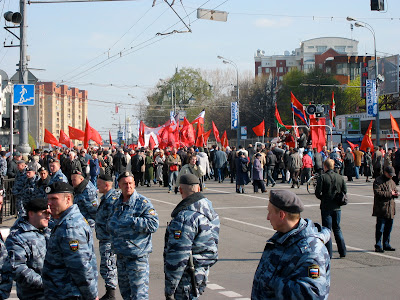
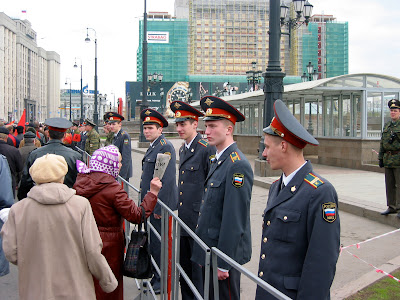
As usual, there were plenty of OMON riot police from keeping the babushkas and dedushkas in line:


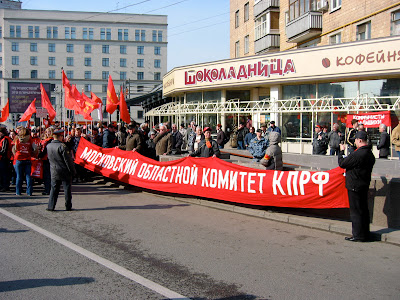
Fortunately in today's Russia, you can get a cup of coffee before joining up with the Moscow Oblast Committee of the CPRF:


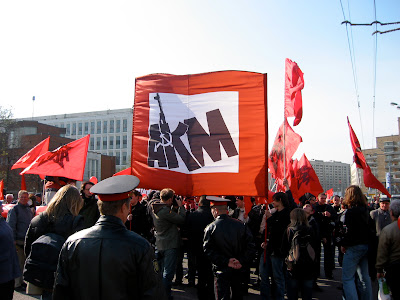
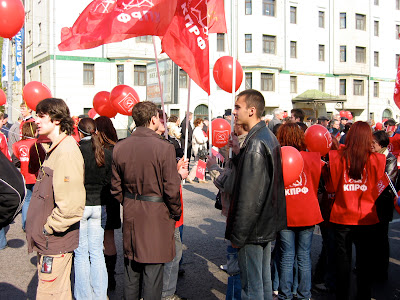
While the vast majority of marchers were elderly (as expected), there were plenty of young people there representing the Vanguard of Red Youth and various regional Komsomol chapters:


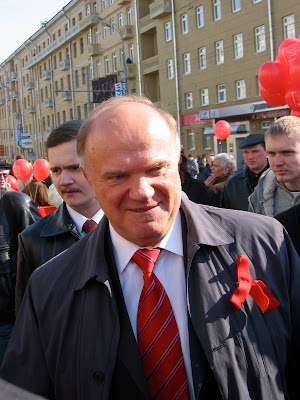
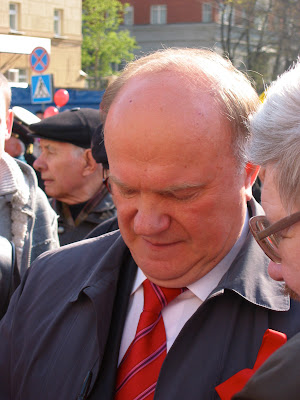
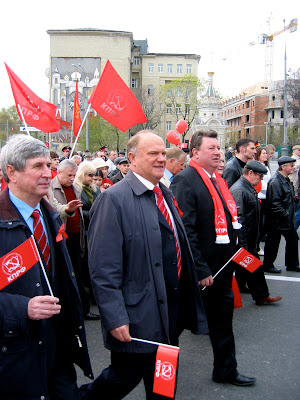
I managed to squeeze my way to the front of the line and got some photos of Gennady Zyuganov, First Secretary of the CPRF, the man who almost became president in 1996.


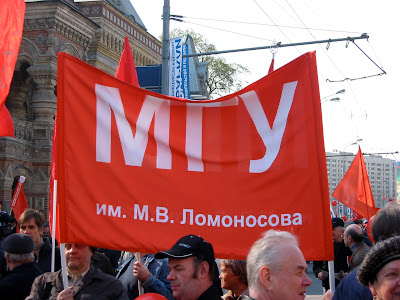
Even Moscow State University was represented. I briefly considered joining up with my "adopted" alma mater, but decided it would be more interesting up at the head of the pack.


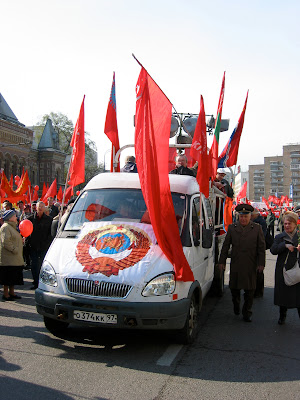
Lenin used to have an "Agitprop" train (agitation & propaganda) that would travel around spreading the Bolsheviks' message. Now they have the Agitprop microbus:


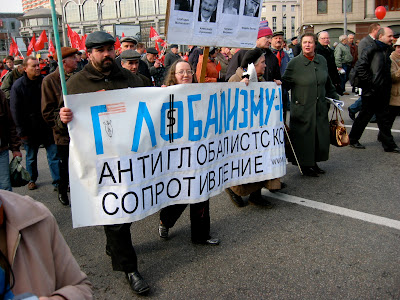
Amidst the red flags were several people carrying homemade signs with homemade messages, including this family of anti-globalists:


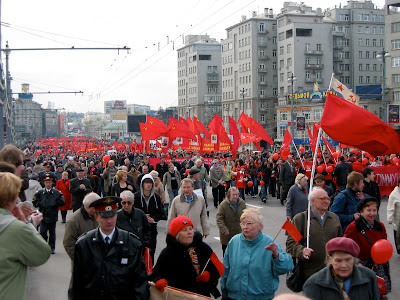
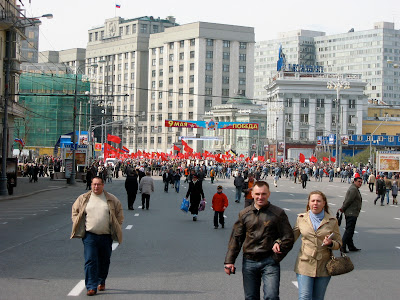
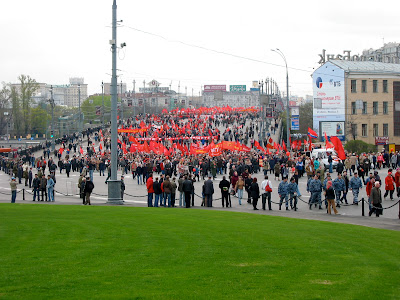
As I was at the front of the crowd, I didn't realize how large the demonstration was until I turned around and saw what was following us:


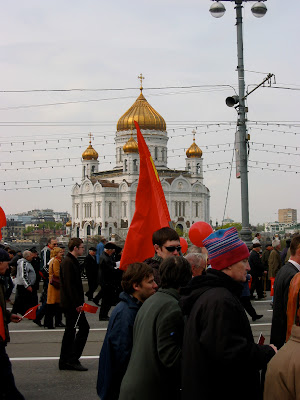
Zyuganov must have given thought to his politicla nemesis of the 1990s, Boris Yeltsin, as we passed the cathedral where Yeltsin was laid to rest last week:


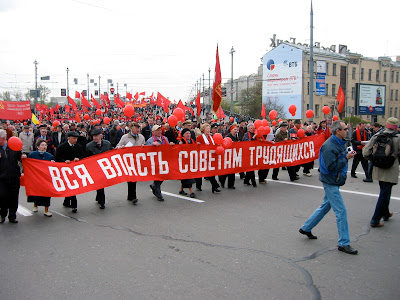
Not surprisingly, the march didn't move very quickly, and the babushkas and dedushkas would slow noticably when we reached even the smallest of inclines. In fact, the distance between the starting point and Teatralnaya Square where the march ended is pretty long. I was a bit worried that some of their tickers wouldn't make it. Nonetheless, the slow pace allowed me to get out in front of the whole group of protesters for some photos:


Taking the lead of the professional photographers, I scurried out in front and right up to Zyuganov with my camera. His bodyguard warned me, "take the photo and get out." So that's what I did.


This young police officer couldn't keep a straight face as he was being lectured by the newspaper-wielding babushka. Remember, people: don't mess with the babushkas.


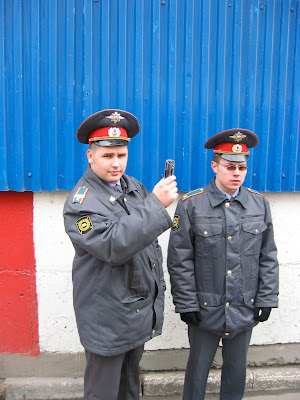
This police officer and I exchanged knowing smiles as we both took interesting photos: Me taking photos of him taking photos of the crowd with his cell phone camera.


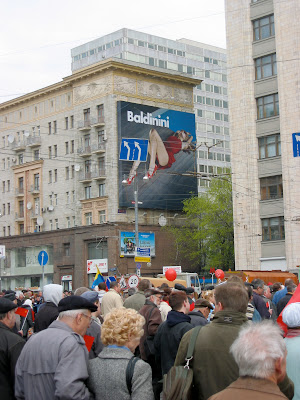
And of course I had to smile when we passed this billboard. At least she had the decency to put on a red dress for the occasion!


Eventually the marchers arrived at Teatralnaya Square. The best line I heard all day was from a speaker who declared, "Comrades, welcome to Sverdlov Square, temporarily renamed Teatralnaya Square." For those of you who don't get the joke, the Soviet-era name was changed in 1991, and I don't get the feeling that it's all that temporary...


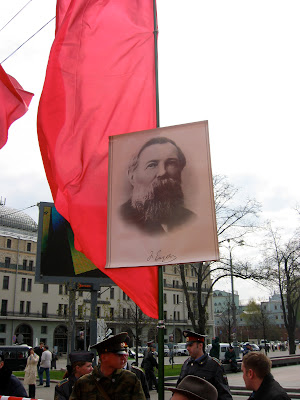
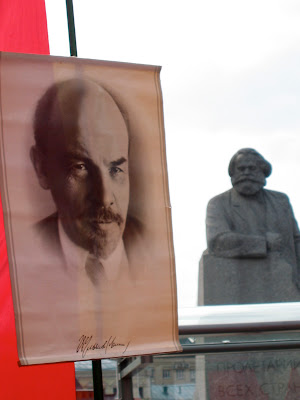
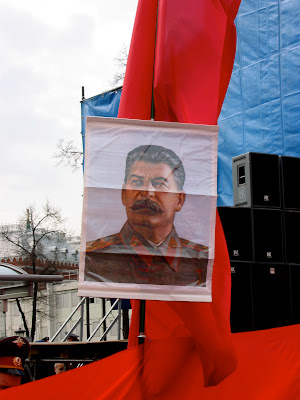
Everyone's favorite members of the Communist pantheon were represented:

Marx (squared):


Engels, the guy everyone forgets about:


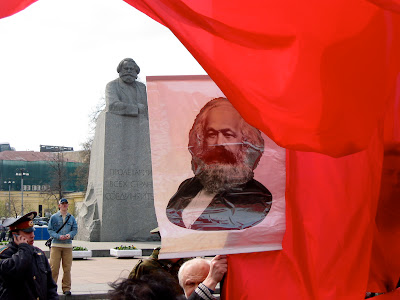
Grandpa Lenin and Great Grandpa Karl:


And of course, Uncle Joe, who always makes a scene at family get-togethers:


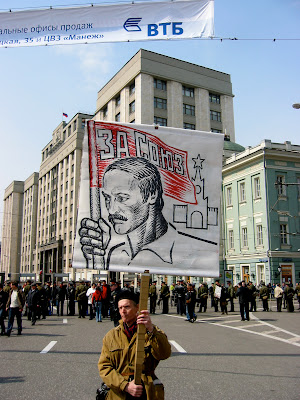
There were several other interesting homemade signs at the protest:

This one portrays Belarusian president Alexander Lukashenko in support of the Russia-Belarus Union:


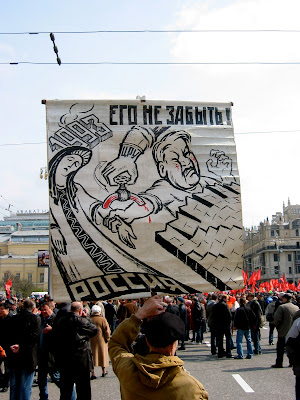
On the reverse of the same sign is a depiction of Yeltsin draining the blood of Russia in order to save his own life:


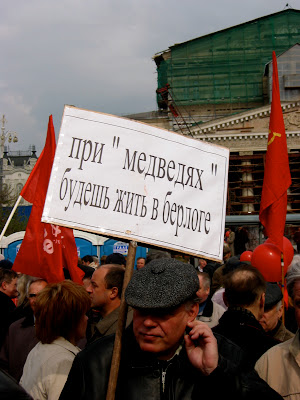
This one states, "Under 'the bears' you will live in a den," a play on words using the Russian word for "bear" (medved) in reference to one of Putin's possible successors, Dmitri Medvedev:


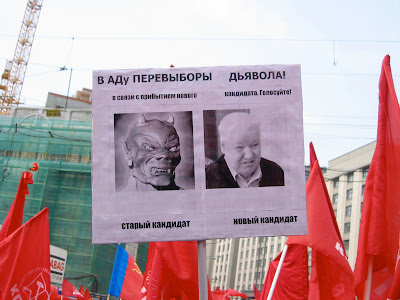
Finally, this tasteful number... It states, "In Hell there's a new election for the devil in connection with the arrival of a new candidate. Vote!"

You can see for yourselves who the old and new candidates are...


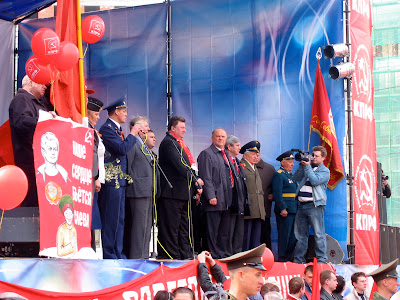
As for the speakers up on stage, there was nothing too interesting or new going on - the same old message, the same old slogans. They did refer to the current unrest in Estonia surrounding the removal of the Bronze Soldier monument, but other than that it was a pretty bland demonstration. While they may still be the largest opposition group in Russia, it's easy to see that they're not the most impassioned group.

And so, after a while I got bored and decided to go in search of some of the other rallies, heading up toward the Lubyanka:


Stay tuned for part 2...

See the rest of the day's photos here.

27 April 2007

Child of Hungry Times

I recently had the pleasure of attending the Moscow premier of Child of Hungry Times, a one-woman play written, produced, and starring Bridget Bailey, a friend of mine here in Moscow. The play, performed in English, is based on the writings of Russian writer Lyudmila Petrushevskaya who produced touching - and often controversial - portraits of Russian women and their place in Soviet society.

I have yet to decide which I find more impressive - the power of Petrushevskaya's characters, or Bridget's skill in bringing them all to life (she plays six separate characters, giving unique vitality and identity to each one). Obviously, the great achievement of the show is the combination of Petrushevskaya's groundbreaking writing (which was too controversial to publish during much of the Soviet era) and Bridget's own remarkable acting gifts. I think I might have to see the show a second time to decide which aspect is more impressive.

And so should you, if you happen to be an English speaker in Moscow this weekend.

The play is showing in the Zal Vladimir (mezzanine level) at the Baltschug Kempinski Hotel in Moscow on April 28th and 29th. The show begins at 8:00 pm and tickets are free, though they would be well worth paying for if we had to!

I strongly encourage anyone reading this in Moscow to attend if they're able.

And, for those of you reading this from the comfortable bliss of the United States, do not despair. Mother Russia is losing Bridget this fall when she returns to the states to persue a production of Child of Hungry Times off Broadway in New York. So with any luck, we'll get to see this impressive show back home too.

26 April 2007

Food for Thought

I have a complicated relationship with food in Russia. Which is to say that I have a complicated relationship with Russian food.

It's not that I don't like Russian food. It's just that when I'm in America, I usually crave Russian food about once a year. On that day I pull out the Russian cookbook, make some pelmeni by hand and a pot of borshch, after which I'm set for another year.

I've found that I crave Russian food at about the same frequency when in Russia, which is problematic due to the fact that I'm eating it every day, not just one day. Thus, there seems to be an oversupply problem, not something you find in Russia very often...

I wake up every morning to find my breakfast waiting for me on the table (meals are included in the rent I pay my host family). I sit down and stare at the bowl of porridge in front of me. 75 percent of the time it's kasha. The rest of the time is split between millet, oatmeal, and rice porridge. It's already been sitting on the table a couple of hours because host mother usually leaves for work fairly early. So I pick up my bowl and stick it in the microwave for one minute twenty seconds. Every morning.

When I get back to the table with my steaming bowl of kasha, I sit down and pour in some milk to help wash things down. I'm not sure if I'm supposed to do this, but I tried it once without the milk and once was enough. Then I get up to search for the sugar, which has a habit of wandering all over the apartment. I don't know why. Eventually I find it and am ready for my daily dose of fiber. Sometimes there is other fare to accompany my kasha - cheese, salami, yogurt. Sometimes the other things aren't there. I'm not sure why host mother decides to serve me the extras some days and not others. Maybe she thinks to herself, "hmm, R is looking a little chubby today. Maybe he shouldn't have any cheese." Actually, since she's a Russian woman reaching babushka stage, she probably thinks, "hmm, R is looking a little thin. Maybe he needs some extra cheese today." Most likely she simply doesn't think about it at all, as she's not exactly the doting type...
On weekends there are usually these thick pancakes (not blini) that have a deliciously crunchy crust thanks to the fact that they're practically deep fried in the massive quantity of oil that goes into the pan. One time I tried to complement my host mother by telling her how good they were and how I'd like to get the recipe.

"I don't understand..." (this is how she starts most conversations with me). "I make these all morning and you just sit in your room reading when you could come out and write this all down. I don't understand" (this is how she ends most conversations with me). But a bit of sugar, some smetana (sour cream), and jam on the pancakes makes everything OK.

Because host dad and I both work from home, we usually have lunch together. My friends at home will attest that you could set your watch to my lunch schedule - when the clock strikes 12:00 I become one of Pavlov's dogs. European readers will be comforted in knowing that I have managed to push this back a couple of hours in accordance with host father's preferred dining schedule. However, the call, "R, are you having lunch?" can come anywhere from 2:00 to 4:00. Lately I've been keeping a jar of pickles on the balcony just in case it's a late lunch day...

Lunch always always begins with the soup of the week. Host mother usually makes a big pot on Sunday night, which lasts us the week and lives out on their balcony. Sometimes it's shchi (cabbage soup), sometimes it's borshch, and sometimes it's a soup with pickles called rassolnik. One time the rassolnik had bits of liver in it, which was not a good week. And of course, readers are familiar with the trauma of the dreaded ukha (fish soup). Fortunately the ukha has not returned since that terrible week. If it does, it may not be enough to slip out for the afternoon; I may have to head to Kiev for the week...

When they don't contain offal meats and second-grade fresh fish, the soups are actually quite good. Though I have to admit that soup every day gets a bit...repetitive. I try to vary things by adding smetana to my soup in the Russian tradition some days but not others. But then host dad inevitably asks why I'm not putting smetana in the soup, "since it's much better with smetana." Given his enthusiasm for the stuff, it's usually more appropriate to describe it as "sour cream with soup added" rather than vice versa.
The second course for lunch always consists of mashed potatoes (made from flakes). This is not a joke. I have not had a single lunch at home that doesn't include mashed potatoes. There is also usually some sort of meat to go along with it. Most of the time it is an underseasoned and patty of ground meat known as kotlety. Sometimes the kotlety are undercooked and pink on the inside, which is why I now insist on taking a short detour to the microwave between courses. I, for one, don't have a lot of faith in post-Soviet meat quality standards and prefer to avoid medium-rare mystery meats.
A generous dollop of mashed potatoes and several kotlety go into the frying pan that hasn't been washed in ages. Now, I know the nonstick wonder that is well-seasoned cast iron cookware. But when black flakes from bygone meals end up in every bite, I think it might be time to give it a good scrub. Along with the potatoes and kotlety goes at least a quarter cup of oil for good measure. Just in case the non-stick layer developed over decades of not washing decides to go on tekhnicheskii pereryv... And so, eventually the potatoes, kotlety, and most of the grease end up on my plate and into my stomach.

In contrast to the predictability of breakfast and lunch, dinner is anyone's guess. Its timing depends on when host mother arrives home - sometimes as early as 7:30 or as late as 11:30 if they go to the theater, but usually somewhere in the middle. The problem is that nobody ever tells me which it's going to be. If it looks like it's going to be a late nighter, I'll make something for myself (usually eggs, as they tend to be the only thing in the fridge amenable to culinary transformation) or I'll go out and get something at a cafe or restaurant. It never ceases to amaze me when, at 11:30 at night, my host mother returns home and is surprised when I tell her that I already had dinner and won't be joining them. Did you really think I was going to wait that long?

While we're on the subject of the fridge, I suppose I should address its contents. First of all, it is packed to the brim, as is the freezer above and the separate standalone freezer nearby. In fact, all three containers are so full that anything behind the first row or two of food items is literally inaccessable. I've dug around back there a time or two looking for a pickle (I guess I've developed a taste for the things) and have become quite unnerved upon seeing some of the occupants of the fridge's depths. I'm sure some of the contents still have fond memories of the Brezhnev era...

Also, it would appear that host mother isn't a fan of things like plastic wrap for covering dishes and wrapping up opened items. So we end up with a lot of dried up cheese and moldy vegetables that go quite some time before being noticed (by her, not me). The result is that cornucopia of odors known as "fridge funk," which in turn permeats all the open packages in the fridge. I sometimes wonder which is worse - the moldy food in the fridge or the milk that they left out all night and the kotlety that stay in the frying pan from one day to the next. And I wonder what my last thoughts will be as I keel over dead from food poisoning.

You may wonder why I don't say anything about it. Well, the fact of the matter is I'm afraid of my host mother. But that's another story... In the meantime I just cut off the crusty parts of the cheese and I put away the milk that they leave out.

Now, where were we? Oh, dinner. Usually there's more soup of the week. If she's feeling ambitious there might be something that's actually cooked - frozen pelmeni (dumplings), pan-fried meat (with plenty of oil), butter-drenched pasta, along with some kind of marinated or pickled vegetables. Oh, and don't forget the potatoes. On nights when she's tired, the best you can hope for is a plate of tvorog (cheese curds), which are to be covered in sugar, sour cream, and jam. Not exactly the meal of champions, but I don't complain.

This isn't to say that she can't cook. In fact, I've seen her put out truly impressive spreads of zakuski (appetizers), "salads", and tasty treats like fresh-baked pirozhki when guests come. While on the subject of salads, those of you not familiar with the Russian "salad" might be somewhat disappointed with such a "salad" if you ever have the opportunity to eat said "salad." I use "salad" in quotations because it is not the leafy bed of greens you've come to expect in the West. Rather, most Russian salads consist of cooked and chopped vegetables and sometimes meat tossed (drowning) in mayonaise or a similar "dressing." One version even contains pickled herring; you can imagine how I feel about that one.

Did I mention the dill? Apparently this is the only herb that grows fresh in Russia because it has found its way into damn near every dish on the table. I once loved dill. Now it too falls in the "once a year" category.

Of course, I eat everything in front of me because my mother taught me to be polite. Perhaps too polite. Sometimes they set a place for me, with soup and food already served before asking "R, do you want lunch?" Despite the fact that I had lunch at a cafe 2 hours ago and it's somewhat strange that they're eating lunch at 5:00 on a Saturday, I don't want to be rude, so I reluctantly eat lunch again. I also don't know when dinner will come again, so I hedge my bets and dig in for the long haul.

Now, none of this is to say that I dislike Russian food. Ok, I don't like the ukha. Or the liver. Or the things growing in the fridge. Or all the grease that soaks into the kotlety and potatoes. It's just that I don't really love Russian food. Which is why I only need it once a year.

My host mother thinks otherwise:

"I can tell you love Russian food, R., since you eat everything we give you."

I smile and nod, partly out of politeness, partly out of fear...