17 September 2008

Kvas: Magic in a bottle

The clock is ticking and my time in Ukraine is quickly drawing to a close: in two weeks, almost to the hour, I'll set foot on my native soil once again. This will also mark the completion of my field research for my dissertation and as such, the last time I'll spend an extended period of time in the former Soviet Union, at least for the next few years. Because I don't have anything interesting to say about America (indeed, the circus seems to speak for itself), I have a sneaking suspicion that this will be one of the last posts on Darkness at Noon for some time.

Given that this is the end of a personal journey that has taken me to some of the most fascinating and bizarre places on earth over the last two years, you might think that I'm going to wrap up with a thought-provoking, introspective look at how my experiences have helped me grow as a human being. Or maybe I will draw some sweeping conclusions about the people and places I've seen. Maybe I'll declare that I've finally come to understand the Russian Soul, the Ukrainian Nation, or the Belarusian, um, Potato.

Nope. I'm going to devote these final words to the most magnificent of bubbly brown drinks, kvas. I've got a bottle of the magic elixir just inches away from my grasp even as I pen these lines, just waiting to take me back to a simpler time and place. You see, unlike 99.7 percent of non-Slavic people in possession of their full mental faculties, not only can I stomach the stuff, I am deeply and passionately in love with the bewitchingly aromatic, palette-tingling, mildly fermented beverage made of stale black bread. I love kvas so much that I even write poetry about it:

Квас, квас!
Как люблю Я Вас!

Kvas, kvas!
How I love you!


That's all I've got so far. I know it's not much, but it rhymes (in Russian) and I'm pretty sure that's the most important thing for a poem. Someday maybe I'll even share my poetry series on public transportation which is equally impressive... But in the meantime, we have tasty verses about kvas to quench our thirst for culture.

To be sure, kvas is the national drink of the East Slavic peoples. Vodka doesn't count because it is consumed largely for its well-documented medicinal benefits. Or at least this is what a local guide in Odessa recently told me. And while beer is certainly witnessing an impressive surge, nothing quenches that deep down latent-peasant thirst like a big mug of kvas. I'm sure Tolstoy would agree with me.

In fact, the work of another talented poet (much like myself) stands as testament to kvas's importance to Russian life. In Evgeny Onegin, Alexander Pushkin writes:

They needed kvas like air; at table
their guests, for all they ate and drank,
were served in order of their rank.


Now, I don't know if it rhymes in Russian, but I'll assume so since Pushkin is generally considered to be a pretty talented poet and clever rhyming is the hallmark of all great poets. Needless to say, it's telling that the father of modern Russian language and literature would focus his genius on this humble beverage, without which Russians could not survive.

Kvas's immense popularity is not just limited to the days when guys like Pushkin rode around in troikas and got shot in duels. In fact, kvas is apparently the fastest-growing soft drink market in Russia today, with sales increasing by 43 percent in 2007. It's probably no accident that I spent much of 2007 in Russia, but I don't think that I alone was responsible for the surge in demand. Rather, kvas is the summertime drink.

And why shouldn't it be? After all, ask any Russian why kvas is so great in the summer and you'll get the same answer from every single one: "it's refreshing!" And they're right, it IS refreshing! Better yet, it's versatile too: chop up some raw vegetables, a boiled egg, a forest's worth of dill, and any mystery sausage/meats you have lying around, pour some kvas over it with a big dollop of smetana, and you've got okroshka a refreshing cold summertime soup. Did I mention that it's refreshing? Because it is...

So enticing is kvas and its special place in Russians' hearts that Coca-Cola launched their own kvas label in 2008 called "Mug and Barrel." Doesn't that just make you want to pick up a sickle and go out and harvest some wheat? Well, maybe not - I've actually tried Coke's kvas, and while it's pretty good compared to the other bottled brands available for sale in stores, it, like all bottled kvases, is no match for the amber liquid bubbling away on babushka's window sill. For manufactured kvas is produced today just like any other soft drink: carbonated water is added to a flavored concentrate which probably never even touched a stale piece of black bread in its life.

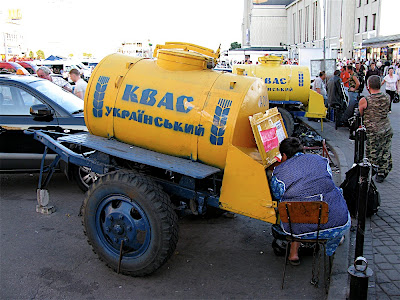
No, for delicious authentic kvas your inner peasant will have to turn elsewhere. One deceptively attractive option is the ubiquitous kvas tank found on street corners throughout Russian, Belarusian, and Ukrainian cities, often accompanied by a buxom female attendant that resembles her kvas tank both in shape and demeanor. Often yellow in color, the tanks are also easy to identify by the helpful description inscribed in large letters on the side of the tank - КВАС - just in case you get them mixed up with the tanks dispensing martinis on the opposite street corner...

Here are a couple of examples of kvas tanks, the first in Kiev and the second in Sevastopol:
From Darkness at Noon


From Darkness at Noon


As you can see from the photos, they're rather mobile beasts (the tanks, that is, not the attendants): each tank comes with a trailer hitch and a set of wheels. At night when it's time for the kvas tanks to sleep and get refilled, they get hitched together in long chains, snaking through the streets behind a truck. Whenever I see a parade of kvas tanks in the city I have to restrain my urge to join the parade or simply run after it like a dog chasing a car on a country road. Because it IS refreshing, you know!

When you come across a kvas tank, you will likely see the customers standing around the tank enjoying their beverage right there without leaving the vicinity of the tank. This phenomenon has its roots in the Soviet era, when kvas tanks were ubiquitous but cups were not. Back then there was but one cup for customers and thirsty Soviet citizens had to line up for their refreshment, just like they lined up for everything from cabbage to Lenin. After each customer was served, the attendant would dip the communal cup into a bucket of water to "wash" it (I use the term loosely) and then fill it for the next customer. Not exactly hygienic, but then again the Soviets were never really known for their attention to little details like this. The point is, you couldn't wander away with the only cup (I imagine that would be enough to get you arrested since denying people their kvas would constitute oppression of the proletariat) so people became trained to stand at the kvas tank while quenching their thirst. While the communal cup has been replaced with disposable plastic ones (everyone gets his own cup), the conditioned behavior remains: people stand around the kvas tank sipping from their plastic cups as if held there by Comrade Brezhnev's invisible leash...

While the probability of catching a nasty bug from the communal cup has gone down, unfortunately the prospect of catching something unpleasant from the contents of the tank has risen considerably since the good old days. There wasn't much that the Soviet economy did well, but maintaining quality control on kvas was apparently one of them. Since the Soviet collapse, I am told that quality control has gone down the drain, and much of what should go down the drain ends up in the kvas tank. As such, I have been warned by several locals not to drink from the kvas tank, lest I wish to spend a week in very un-refreshing discomfort.

So what is a kvas lover to do if the bottled stuff doesn't cut it and the stuff on the street corner deserves a "thanks, but no tanks..."?

If you're lucky enough to have a babushka around, you should have started with her in the first place. I probably should have mentioned that at the beginning, sorry. If you don't have your own babushka, I suppose you might be able to rent one of the little ones selling flowers outside the metro station and convince her to make some for you. But if this approach fails, you're on your own - you gotta make it yourself.

This is the point where all you Americans can just stop reading since you think the stuff is wretched anyway. And you Russians, Ukrainians, and Belarusians can stop reading too since your babushka can do this in her sleep. So I guess that leaves us with a few Aussies, a couple of Brits, a handful of Canucks, and the occasional Dane. So welcome to the few of you that are still with us and want to learn how to make kvas.

Like most things worth having, making kvas is more of an art than a science. I say this because it sounds a lot better than saying, "every time I make kvas it comes out different." But I do have several homemade batches under my belt by now, so at least I can tell you where things are going to go wrong despite the fact that you're following the recipe...

Here's the basic recipe I use, which I've tweaked a bit based on experience. I should also point out that there are as many kvas recipes as babushkas, so I don't claim to have the "best" one. If you've got a babushka with a better recipe, by all means, send it my way!

1 lb stale black bread or 1 lb stale pumpernickel bread
1 cup sugar
a few raisins
2 tablespoons fresh mint leaves or 1 tablespoon dried mint leaves or a packet or two of mint tea.
1/2 teaspoon Active dry yeast (or more or less, I'll discuss below...)
1/4 cup luke warm water

-Cube the bread and let it dry completely. You can do this on a cookie sheet in a low-temp oven, or just let it sit out for a few days. I think the stuff in the oven tastes better and it makes the kitchen smell like black bread. Mmmm, Borodino! The darkest black bread you can find is the best - the stuff that seems denser than pig iron. If you can't find that, pumpernickel does work fine.

-Bring 6 quarts of water to a boil and add the bread cubes. Cover it and let it sit at room temp for 8 hours or overnight, whatever works for you.

-Strain the juice (mmm, bread juice!) through several layers of cheesecloth - you don't want bread chunks floating in your kvas. Alternatively, you can use an old (but thoroughly washed) pillowcase. But don't tell my landlady that I suggested this - I don't think she'd be happy knowing I've been using her linens to strain my kvas....

Carefully pour the juice through (making sure you have a vessel underneath to catch it) and dump the soggy bread goo into the pillowcase. You can hang it up and let it continue to drip drain, but I'm usually too impatient to wait for too long and you never get that much extra liquid out anyway.

-Put the yeast and a 1/4 teaspoon of sugar into the luke warm water and let it dissolve. Put it aside for a few minutes while it gets excited an bubbly. Can you blame the yeasties? They want to be refreshed too!

-Dissolve the remaining sugar in the bread juice and add the yeast mixture and the mint. Stir everything to dissolve well, cover it with a towel, and set it aside for another 8-12 hours at room temperature.

-Strain the stuff again if you've got little things floating in it like renegade bread goo, mint leaves, or dill (which somehow finds its way into everything Slavic but is best left out of kvas)

-Add the raisins and re-cover. Put it in a cool (but not cold) place if possible, otherwise room temperature works fine too. Then you wait for the raisins to float up to the surface. My original recipe said that this would happen in 4-5 days, but it only takes one day for most of my batches. In general the fermentation process depends on three factors: 1) the amount of yeast turning sugar into alcohol and carbon dioxide, 2) the amount of food (sugar) the yeast has to consume, and 3) the temperature at which fermentation takes place. More yeast and higher temperatures will produce faster fermentation, and if you let it go long enough all the sugar will be converted and fermentation will stop (though I don't know how much sugar & time would be required for it to become anything more than minimally alcoholic).

But before you kvasaholics get ahead of yourselves and triple the yeast to hurry up the process, a word of warning: once you bottle the stuff and refrigerate it, fermentation and the resulting carbonation will continue to take place if there is still sugar in the liquid. The original recipe I used called for 2 TABLESPOONS of yeast, and my bottles were gushing violently upon opening them after only a couple days in the fridge. By contrast, homemade root beer recipes call for 1/8 TEASPOON of yeast which is enough to carbonate a gallon of soda. Ultimately you'll have to experiment with what level you prefer between these extremes. Using less yeast will take longer to achieve that nice sour/sweet balance that is good kvas, but then you won't have as many volcanic eruptions in the kitchen later on.

-Regardless of how much yeast you used, at some point your raisins should start floating because they are bloated and gassy, much like the kvas tank attendants you now know to avoid. At this point taste the kvas. If it's pleasantly sourish with still a bit of sweetness, and if you like the way it tastes, you can go ahead and bottle it. If most of the sugar has been fermented already and you'd like it to be a bit sweeter, add some sugar a little at a time until it tastes good to you. Or, if it's still too sweet and not enough sour, then let it ferment some more.

-When you are satisfied with the taste, filter it one more time to remove the raisins and anything else that might still be in there. Pour it into bottles and cap them tightly.

-At this point you have a choice depending on how much yeast you used. If you used a lot of yeast, they will continue to ferment enough in the fridge so that carbonation will develop there (assuming there's still some sugar to ferment and your kvas hasn't gone completely "dry"). If you used the minimum amount of yeast, you can leave the bottle at room temperature for several days while the carbonation builds up, testing it every day or so to make sure you don't over carbonate. Once it's bubbly to your satisfaction, stash it in the fridge.

Once it's chilled, there's only one thing left to do: pour yourself a big mug, kick back, and enjoy that delicious kvas down to the dregs.

Because after all, it's refreshing!

01 September 2008

Lost and Found

One of my most loyal readers declared yesterday (over email), "Your blog is strangely silent - are you too busy to write about all the things you see and do?" A fair enough question, and one that deserves an answer...

The fact of the matter is that yes, I've been quite busy, much more so than during my time in Russia last year. Not only did being forced to relocate to Ukraine swallow up a fair amount of time and attention (I spent most of June learning the ins and outs of the Kiev rental market. Not pleasant...), but Ukraine itself has taken up quite a lot of attention as well.

In fact, the last two months feel like a dizzying Ukrainian whirlwind - I've crossed this fascinating country from north to south, east to west. I've talked to nationalists in Lviv, miners in Donetsk, and farmers in the Ukrainian heartland of Podillia. I've seen Russian and Ukrainian sailors walking side by side in Sevastopol, gawked at crispy red sunbathers oozing onto the beaches in Yalta, and watched young children playfully skipping down the Odessa steps. At times it has been relaxing (10 days sailing the Dniepr and Crimea can do wonders for your soul) but mostly it's been exhausting as I ascend dark stairwells in run-down apartment blocks, ringing countless doorbells in search of interview subjects.

But despite the darkness, the exhaustion, the sore feet, and the frequent frustration of doors shut in my face, it has been nothing short of a truly enlightening experience. I won't try to sum up the Ukrainian people, nor will I even attempt to characterize those that I found in the West, the East, or the center. That, I'm afraid, will have to wait for the dissertation. But what I will say is that Ukraine's people make it a remarkably complex and multi-faceted country. While such diversity is one of Ukraine's most intriguing gifts, it is also one of her greatest dangers, as the divide across the country on even the most basic issues is immense. The future - dare I say the survival - of this country will depend on the ability of these diverse people to coexist in the same country, and it remains a monumental challenge.

And so, "I've been busy with research" is part of the explanation for my silence on this blog. But it is not the only reason. If one were to dig among the posts throughout the lifetime of this blog, you would quickly see that my best material - most of my material - comes from ordinary experiences I've had while traveling. Specifically, they are based on the gap between expectation and reality in a part of the world where reality is sometimes too bizarre to understand. Put another way, this blog has been about Russia, Belarus, and Ukraine through my eyes, an endeavor that has attempted to illuminate both the subjects that I view but also the lenses through which I view them. For absurdity is the eye of the beholder: to me it is amusing, to the girl wearing the shirt that proclaims, "Sexyrural world of promise" it's simply a pretty shirt.

I have a suspicion that my reticence on this blog during the last couple of months has been the result of a narrowing of the reality-expectations gap, leaving me with less "A" material to write about. I suppose it's entirely possible that Kiev is less absurd than Moscow, and that this is why there's less for me to comment on. But I doubt it. Rather, I think that after almost 12 months abroad during the last year and a half, my expectations more or less conform to reality here. The lenses through which I view my surroundings have changed their focus, redefining what I see and how I see it.

It is not that my surroundings - whether Ukrainian, Belarusian, or Russian - have become any less absurd. Rather, they've become normal in my eyes. And therein lies the problem for the blog - when "Just like a thousand pound football, I will challenge with my invincible power" starts to make sense as a catchy t-shirt slogan, you know that you've been here too long. And you know that you're probably starting to do absurd things that the new arrivals are making snarky comments about. Like the plastic grocery bag, now patched with duct tape, that I've been carrying around since Minsk...

In short, I fear that I've become somebody else's "A" material without realizing it.

So is this the end of the Darkness? Well, not quite. I still have a couple of tricks up my sleeve and I haven't gone so completely native that I can't shake my head in wonder at the man who was spitting water on his appreciative girlfriend in the sweltering heat of August. But there is a big bottle of kvas and a sack of potatoes in the kitchen serving as a subtle reminder that maybe I'm not quite right in the head anymore...

13 August 2008

Thought on Georgia

Having just returned from a lovely vacation in Crimea where I had only sporadic news on the conflict in South Ossetia, I have come to the following conclusion:

Regardless of whether you're right or wrong, and no matter how many friends you think you have, it is rarely a good idea to poke a hungry bear with a stick. He's got the teeth and you have a stick. You do the math...

It's a lesson that I hope Ukraine will heed. There was some talk that Kiev might not allow the Black Sea Fleet back into Sevastopol (incidentally, I was there the day they set sail for Georgia...). I hope it is just rhetoric and not an indicator of true intentions. For as much as I support Ukraine's sovereignty and its ability to make its own decisions about its future, there is no getting around that fact that this is still a realist world (following the traditional usage of the term "realism" in International Relations theory). It is a struggle for power and security is zero-sum.

Georgia has shown us that if provoked, the bear will fight back with surprising ferocity. Given Russia's reaction, it seems apparent that there are some fights that just aren't worth picking.

10 July 2008

Chernobyl: Photos and Video

In addition to the written impressions of my visit to Chernobyl, I am posting my visual impressions of the place, as captured in some photos and video I took. I hope you enjoy them...

Click here for photos

Video:

09 July 2008

Chernobyl: life after death, or somewhere in between

Where do I even begin? I've been avoiding this for almost a week now because the task seems too great for my abilities, the weight too overwhelming, the gravity too humbling.

I know that even if I had the ability, I don't have the right. I am an outsider, a visitor who will be there one day and gone the next, probably forever. I haven't shed the tears with my own eyes or felt the suffering in my own body. They have lived the tragedy; I have simply taken a fleeting glance at the shadows of tragedy. So who am I to reflect on the tides that have washed over humanity in that little corner of northern Ukraine, tides whose power and force I can never fully grasp?

And yet this forum remains an exercise in reflecting on my observations, perceptions, and feelings about the people and places I encounter along my journeys through the former Soviet empire. As such, I can promise nothing more than that. This is neither historical, political, nor social commentary about that event and the shock waves it sent through the Soviet Union and the entire world; others can and have met that challenge better equipped than I. All I will offer here are impressions, impressions of a place I never expected to see with my own eyes. They are the impressions of my visit to Chernobyl...

What I expected to find was a place of death. From the crumbling and decaying sarcophagus surrounding the still-deadly remains of reactor number four to the cities and towns abandoned in the days following the terrible accident, I was prepared to encounter a place permanently suspended in a deathly state. I pictured some sort of post-apocalyptic world where life had been scoured from all surfaces, rooted out from all nooks and crannies; I pictured a world that had faded and turned grayish brown, like a long-forgotten film that has been discovered after years collecting dust.

What I found, much to my surprise, was a place characterized by abundant life. The most startling aspect was the human life within the Chernobyl exclusion zone and at the nuclear power plant itself. In fact, 4,000 people are still employed by the power plant and work there on a regular basis. They are the workers who not only monitor reactor four and maintain the aging sarcophagus, but also those who are carrying out the closure of the remaining reactors, the last of which was finally shut off in 2000.

They work and even live inside the exclusion zone because this is their job. The guide at the power plant's visitor center tells us with a tinge of sadness in her voice that "back when the disaster first occurred people rushed here to help contain the situation because it was their duty - they were motivated by love of their country and they paid a high price. Now they come [to work on the Sarcophagus] because they need the work, they don't have a choice." We are told that the power plant takes the health of its workers very seriously - if anybody shows signs of radiation-related illness, they are immediately and permanently removed from the exclusion zone. Discovering the ironies that populate the darker corners of life, someone in our group asks, "doesn't that mean they lose their job, too?" The guide shrugs with a melancholy look of regret on her face and nods her head.

A much different vision of life can be found in Pripyat, the model Soviet city built in the 1970s to house the population that would be working at the Soviet Union's latest wonder-achievement, the Chernobyl Nuclear Power Plant. Home to nearly 50,000 residents at the time of the accident in 1986, the city was evacuated three days after the explosion, never to be repopulated again. Because the residents were told that they would be able to return soon, they left most of their belongings behind. In fact, they left their lives behind to be re-created in the minds of visitors like myself 22 years later, picturing the daily experiences of an apartment's inhabitants as we carefully step over the broken glass and fallen radiator on the floor.

Contrary of the image in my mind of a barren, windswept cityscape permanently drained of life by the events of that day, in fact life is everywhere. 22 years without human interference has had a startling effect as the forest has gradually reclaimed the territory it was once forced to concede in the name of socialist progress. Houses have been engulfed by the forest, apartment buildings dwarfed by the trees, and streets and sidewalks obscured by moss until little trace of them remains. Nature has even found its way inside several buildings, with trees, shrubbery, and grass growing out the windows from within. We see the telltale evidence of wild boars that wander the city rooting up tasty morsels from her soft, mossy soil. We are told that herds of wild horses roam freely on the open plains, and that native zubry (European bison) will soon be re-introduced to the area.

It is, of course, a strange encounter with life that one has in Pripyat, for everywhere we see wild, natural life growing up through and around the remains of the human life that once occupied this place. We see the birch sapling growing upward next to the abandoned toys of children who have long since grown up and started new lives. We see the remnants of a long-forgotten basketball game - a shoe here and there - in the gym that overlooks the thick green forest threatening to swallow the city and the memories it holds. And we see the hopes and dreams of a country that no longer exists, colorfully emblazoned on the sides of buildings, obscured by the trees that were planted when those dreams were still vivid in the minds of their creators.

And so, while Chernobyl and Pripyat are no doubt "living" places, they are not fully alive nor are they fully dead. They are somewhere in between, poignant reminders of man's power over nature and ultimately, of nature's power over man.

30 June 2008

Change we can't believe in

Another one from the “my (short) life in Belarus” series…

Anybody who has known me for more than a couple weeks knows that I don’t like change. There’s nothing wrong with a little order, stability, and tradition. And so, whether it’s a question of doing away with the allegedly tacky tinsel on the Christmas tree (S, just you wait, it’s coming back next year!) to the latest hair color of my chameleon-esque friends, I tend to see beauty and comfort in the status quo.

But that’s not the kind of change I’m going to rail against today. No, the kind of change that has been causing me the most problems lately is the kind that the cashier gives back at the store. Two different trends intersect in Bealrus to make even the simplest of purchases traumatic enough to send me whimpering in the corner like a lost, wet puppy.

First is what appears to be the universal post-Soviet desire by cashiers for exact change. It’s a request – no, demand – that I’ve encountered now in Russia, Belarus, and Ukraine. What is more, failure to produce the requested change (“look for a ten,” she barks) seems to be considered a personal insult by the woman perched in front of the register, as evidenced by the dirty look she gives you as she begrudgingly doles out her precious small bills.. In the event that she cannot produce correct change due to a lack of smaller bills (a condition brought upon by previous customers who were similarly inconsiderate enough to shop at the store in question), you have three choices: 1) forego the change and eat the difference; 2) wait for a later customer to produce change; 3) forget about that bottle of kvas entirely.

In Russia, the demand for change rarely causes problems for me – I usually have some tens in my wallet, along with a pouch full of one and two-ruble coins. Always something to fit the bill (bad puns are becoming a bad habit, aren’t they?).

But it is in Belarus where the situation becomes untenable, thanks to the addition of a second factor: Belarus’ ridiculous currency, the Belarusian ruble. To give you an idea of the silliness, the current exchange rate is 2,147 Belarusian rubles to the dollar. As such, goods are priced in the thousands – 4,000 for some cheese, 16,000 for some sausage, and so on. Now, higher-order math has never been my strong suit, and doing rapid conversions of totals in the tens and even hundreds of thousands on the fly is a bit taxing.

These two factors – pan-Slavic correct change dogma and absurd currency denominations – collide in Belarus to deliberately torture me for the few seconds I’m standing at a cash register. You see, Belarus has bills in all sorts of denominations, from the hundreds of thousands all the way down to the meager ten-ruble note, whose value is approximately $0.005. And so instead of demanding four rubles (as in Russia), I am faced with orders to find 3,740 rubles to make even change.

The “law of large numbers” states that large numbers are harder to understand than small numbers in foreign languages (at least I think that’s what it states). So unless one is really paying close attention and isn’t thrown off by the Belarusian accent, it is easy to misunderstand what is expected. Wrath ensues.

And even if I do understand what number the woman demands of me, I am horrified when I open my thick wallet, bursting forth with monopoly-like “play money” in infinite denominations. The bills are all out of order, having been hurriedly shoved in there the last time I panicked at a cash register. So when she asks for 1,790 rubles, I’m hopeless and helpless – I could never piece that sum together under such pressure. Rather than risking the wrath of the 8 people in line waiting behind me as I dig through my wallet, I take the wrath of cashier woman, telling her that all I have are large bills.

I slink out of the store, traumatized by the experience, and for what? Some sausage and a bottle of water. I pledge to myself that tomorrow morning I will change my routine, sorting the bills in my wallet by denomination so as to be better prepared next time. But like I said at the outset, I’ve never been fond of change…

24 June 2008

Belarus' Bountiful Table

Frequent readers of this blog (all three of them) know that food was a favorite topic for consideration last year in Moscow (previous discussions of Russian cuisine can be found here, here, and here.)

Since most outsiders are not familiar with the diverse culinary delights that make up traditional Belarusian cuisine, I thought that I would offer readers a brief photographic introduction to these delicacies. I was hoping to present a fully spectacular multimedia event, but sadly I could find neither appropriate music, video, nor fireworks to complement the culinary wonders of Belarus.

I should first point out that in fact Belarusian food is heavily influenced by the cuisines of its neighbors – Russia, Ukraine, Poland, and Lithuania. Not a huge surprise when you consider that Belarus has been Eastern Europe’s “Flying J” truck stop for much of the last 500 years – whenever you’re invading someone, you’re usually stopping in Belarus along the way to grab a bite to eat, fill up the tank, and maybe do some shopping at the cheesy gift shop. And so, it comes as no surprise that much of what you find in Belarus’ national fridge is similar to what cousin Wojciech and uncle Vladimir keep in their respective pantries, having brought them as “gifts” when they were just “passing through.”

And so, we open Belarus’s fridge and discover the following delights:

First off, holodnik, a delicious cold beet soup:


Of course, Belarusians are also fond of borshch, the delicious hot beet soup from Ukraine:


Moving on to the salad course, we have “peasant’s salad in the Belarusian style,” a mayonnaise-based favorite (in fact, all favorite things in this part of the world are mayonnaise-based, including socks*):


Sometimes this salad also comes with smetana (sour cream):


Moving on, we have the ever popular meaty gravy known as matsanka:


As well as tasty zrazy, which are (according to Wikipedia) “chopped pieces of beef twisted into a sausage shape and filled with vegetables, mushrooms, eggs, etc.”:


By now you may have guessed that this is all a painfully long setup for a tasteless potato joke (I’ll leave you to decide whether it’s the potato or the joke that’s tasteless, though). But stereotypes aside (during the Soviet era the kind-hearted Belarusian people were referred to as “bulbashi” – potato eaters – by their big brothers in the communal apartment that was the Soviet Union) they really do love their kartoshki. So much so that Belarus leads the world in per-capita potato consumption, ringing in at a whopping 376 pounds (171 kg) per person per year.

Think about that – eating over a pound of potatoes every day. And that’s just the national average – there are people that eat even MORE than that!

I had been in Minsk for less than 24 hours when I discovered how it is possible to consume so many potatoes in a year. The answer lies in the unassuming little potato pancakes known as draniki. Isn’t that a cute name? Almost makes you want to go up and hug them before scarfing down a dozen. When covered in smetana (sour cream) and maybe some sautéed mushrooms and onions, I assure you that there are few things so delicious in the entire Slavic realm.

I found myself constantly craving draniki, bouncing from meal to meal, café to café looking for a fix. When I told my Belarusian friends about my newfound love, they all declared with unwavering conviction that their babushka makes the best draniki in all of Belarus. Understanding the rules of transitivity, I can draw one of two conclusions: 1) that all of Belarus has descended from the same babushka; or 2) that regardless of who the babushka is, babushkas in general make pretty darn good draniki.

Fortunately, I was invited over for draniki by a real-live babushka while visiting the city of Brest. There I learned the magical recipe – finely grated potatoes, an egg or two, a little bit of flour (not too much), and some salt. Oh, and you have to drain some of the liquid when you grate the potatoes. Then it’s into the frying pan (along with at least a half inch of oil) until they’re crunchy, golden, and delicious!

When we sit down to the table, a bowl of smetana is placed in front of me. I gingerly take a dainty dollop and plop it down onto my little greasy paradise. I am immediately chastised by babushka: “No, not like that, you do it like THIS!” whereby she folds up a single pancake, plunges it into the bowl, and manages to scoop up a good quarter cup of smetana before tossing it all down the hatch. Babushka’s corresponding dedushka sits there and just smiles at me with his wonderfully endearing sparkling gold smile, a bit of renegade smetana dribbling down his chin.

Upon returning to Minsk I decide that I must make draniki for myself. After all, by this point I am on my way to being yanked out of the country, so I’ll need to take draniki skills with me if I am to survive outside of Belarus. I go to Mink’s massive Kamarovka market and wander through the aisles of fresh(ish) produce piled high. It turns out that potatoes warrant their own section of the market, so I set out in search of the superlative spud.

I soon find a woman whose countenance resembled that of the bounty she was selling – russeted, pock-marked, a little dirty, but firm. Oh, and she had nice looking ‘taters too. I ask the woman for half a kilogram of potatoes, not really sure how much either a potato or a kilogram weighs (don’t forget that I, like all Americans, am ignorant of metric equivalents).

“What can you do with half a kilo of potatoes?” she asks me (mind you, this is one day’s serving of potatoes in this country). I momentarily contemplate explaining how I’m here on a research fellowship but that my wife is back at home in the States so I’m single, plus I’m being withdrawn from Belarus for political reasons so I won’t be here long and won’t have time to eat my 171 kilos of potatoes this year so I only need a few….

Instead, I just shrug my shoulders and she weighs the tempting tubers on her scale before rolling them into a sack.

At home I discover why God created food processors on the eighth day: finely grating potatoes by hand (even just half a kilo’s worth) is a laborious endeavor. I’m sure that if your average Belarusian man were forced to grate a few potatoes himself he’d be a lot more appreciative of his wife/mother/babushka/food processor. As I reach the end of the potatoes, I notice that I have managed to grate my knuckles, the feeling of which doesn’t improve with potato water and salt mixed in.

Wounded though I am, I soldier on, ending with a plate piled high with the delicious treats. But not high enough – within a day or two I have burned through all the leftovers which, despite turning a grayish blue in the fridge, still taste like heaven. Potato-faced woman was right: I should have bought more potatoes.

Luckily, my dear friend Comrade Kartoshka (no, not her real name) comes to my rescue and feeds my addiction with an invitation for me to try her homemade draniki. While Comrade K is an amerikanka, she has married into a Belarusian family which is enough by way of potato credentials for me. I am on the metro to her apartment before she even finishes delivering the invitation.

What is most memorable about that day is not the draniki (though they were to die for - crispy, golden, and perfection on a plate). Rather, it is the three guys moving what appears to be furniture down the stairs as I step through the entryway to Comrade K’s building. Once my eyes adjust to the dim light I discover that instead of carrying a desk past me, they are carrying an open coffin with a dead woman in it. I cross myself even though I’m neither Catholic nor Orthodox – just seems like the right thing to do. As I look up the stairs I see K’s face poking out into the hallway wearing what I can only assume is the same look of shock that graces my own. The cortege clumsily passes – after all, she was a hefty Slavic woman (God rest her soul) and I dart into the apartment, looking forward to a bit more lively company (sorry, couldn’t resist a bad pun).

K and I are both a bit shaken by the experience, but K’s middle-aged sister in law matter-of-factly tells us that it’s a sign of very good luck. I don’t catch all of the explanation through her Belarusian accent, but I can only assume that it translates to something like, “better her than you.” Indeed.

All I can say is that I hope for her sake – and for my own someday – that they have draniki in heaven. With plenty of smetana, too…

~~~~~~~~~~~~~~~~~~~~~~~~~~~~

*this is not actually true, Russian socks are not made out of mayonnaise.

18 June 2008

Impressions of Minsk

Started in Minsk, continued in Moscow, and finished in Kiev...
*********************

My first three weeks in Minsk – my last three weeks in Minsk, my only three weeks in Minsk – have been one of those surreal time-warps where time simultaneously stands still, the seconds grinding painfully along, and yet in the blink of an eye the days fly by with the speed and determination of an unreformed post-Soviet woman elbowing her way onto the bus in order to get a seat. Three weeks ago I lay on my bunk in the train compartment, the gentle rocking of the train’s movement not quite soothing but not quite aggravating either. I thought with a little excitement and a lot of apprehension about the five months ahead of me in Belarus. I’ll confess, I knew I would be fine but I was dreading it all the same. This is, after all, Belarus.

An hour ago I bought my train ticket back to Moscow, and I’m heartbroken. I would give nearly anything not to leave Minsk. But alas, the price of staying is a heavy one, a price that I cannot afford. To stay in Belarus would be to give up my research fellowship, as the money trail eventually leads back to the U.S. government. Since that government has decided it’s undesirable for me to remain in Belarus, it’s a choice between my heart and my pocketbook. Of course, it wasn’t really a choice, as only one outcome was really possible…

I fell in love with Minsk almost immediately. I will be the first to admit that I have a soft spot in my heart for Stalinist Imperial architecture – some consider it grotesque, I find it austere but elegant. Minsk, or at least the extended city center, is nothing but Stalinist architecture. Grand, well-trimmed buildings in pleasing shades of pastel line the wide streets and well-polished stanchions of granite keep pedestrians from straying off the immaculately clean sidewalks. In some areas leafy green trees spread above playful fountains line the sidewalks, shading Minsk’s residents as they stroll along the boulevards.

Of course, such buildings, streets, and walkways came at a heavy price for Belarus’ capital: approximately 90 percent of the city was destroyed by the end of the Second World War. It seems obvious that geography is Belarus’ great burden, as armies throughout the centuries have spilled her blood as they cross her open fields in pursuit of empire. Though it wasn’t the first, the destruction of WWII was the most devastating tragedy for Minsk - capture by the Germans and re-capture by the Soviets took an enormous toll on the city and the entire republic. Cities, of course, can be rebuilt. But nothing could restore the 25 percent of Belarus’ entire population that perished during the war.

And so Minsk rebuilt. Actually, “built” is more appropriate, as there was nothing left to rebuild: they could only clear the rubble and start from scratch. And it wasn’t Minsk that rebuilt the city, it was Moscow, as evidenced by the monumental buildings and wide boulevards of modern Minsk.

Walking around the city on my first day here, I was taken by how vibrant the city felt. True, it helped that the city was bathed in the warm sunlight of the first clear day in a couple of weeks. But this was clearly not the Minsk I visited back in 2000. That was a dull, muted city where the gray of the sidewalks melted into the grey of the buildings melted into the gray of the skies. Chips and cracks in the facades of buildings flowed into the cracks of the sidewalks as crumbling exteriors served as poignant testament to Belarus’ Soviet heritage and painful post-Soviet transition.

I thought that maybe my recollections from 2000 were somehow colored (gray, that is) by the passage of time and by my own biases projected onto the past: life under dictatorship must be dark and heavy, so their cities must be dark and heavy as well. I went back and looked at my old photographs from those chilly days in November and confirmed that my recollections were accurate – Minsk was a cold, dull city then.

I could but come to one conclusion: in some cases, dictatorship is great for cities. I’ve mentioned how good the city looks to many of my new acquaintances and friends here in Minsk, casually inquiring about what’s been going on during the last eight years that has breathed some color into Minsk. Who has been polishing the stanchions, patched and painted the buildings, and cleaned up the streets and sidewalks?

Of course I know who is responsible – he is responsible. He is responsible for everything here. How could it be otherwise? My friends are unashamed and unafraid to confirm this. He likes to have a clean and orderly city, so this is what they get. They tell me other things about his architectural tastes, recounting the story of the new National Library made of glass in the supposed shape of a diamond which lights up at night. Comrade Kartoshka tells me it looks like a golf ball. I ask my friends where the money comes from to take care of the city and build such things. They tell me about how all the major private companies were “invited” to make “voluntary” “donations” to the construction fund. They also tell me about how a few rubles were “voluntarily” “donated” from the accounts of each Belarusian cell-phone owner in order to “contribute” to the building of this “wonderful” library.

Ah, extraction, long the beloved state building instrument of dictators throughout history! But what to the people get in return? They (sometimes) get beautiful buildings, clean and safe streets, shady green parks, and trains that run on time. During my first few days here I certainly could appreciate the attraction of this bargain. In fact, by external appearances it was easy to overlook the fact that I’m living in a dictatorship. People hang out on park benches having a good time with friends and a few beers. They go shopping in shiny new underground malls, dine in trendy new sushi restaurants, and see the latest American movies. I even managed to catch the new Indiana Jones movie the same day it opened in the U.S. People live their lives, go to work, do their jobs, go home, spend time with their families and friends, and start the cycle again every day.

This is, of course, is why dictatorship can be so deceptive: as long as you look in all the right places, life in some dictatorships is not so bad. Wages and pensions are paid, jobs and apartments are available. Products stock the shelves of stores and people have a good time strolling down the tree-lined boulevards. If one puts on blinders and just looks at what appears on the surface, it is not a bad sight.

But even lifting the curtains a little bit to peek at what lies behind them reveals the all too familiar outlines of autocracy in the dark shadows. I won’t take it upon myself to detail at this time the harsh measures that the Lukashenko regime has taken to suppress opposition. Simply knowing that public display of the pre-1994 Belarusian flag will result in beating and imprisonment should give you an idea of the sort of measures used on those who dare to speak against the regime.

These are the punishments that await individuals who seek conflict with the state. But what of the ways in which dictatorship affects the ordinary lives of ordinary people in ordinary ways? Unlike politically active oppositionists, most citizens do not seek to provoke the regime, yet they obviously feel its effects in their daily lives. This question lies at the heart of my research, research which was unfortunately cut short.

Nonetheless, in my few weeks in Minsk, I captured a few glimpses into this intriguing question through personal experiences and conversations with friends and acquaintances. Here are a few examples:

-As mentioned above, every Belarusian cell phone user “donated” to the construction of the National Library. One might ask how this is any different than when I pay the IRS taxes under threat of being penalized (or worse). But just as I would consider my privacy violated if the IRS automatically reached into my bank account to extract my taxes, so too is there something sinister about the government reaching into the private phone accounts of its citizens for public funds.

-There is a little lane in central Minsk that is only one car-lane wide. And yet nobody crosses without the “walk” signal… ever. Did I mention that it lies nestled between the KGB building and the bust of Soviet secret police founder Feliks Dzerzhinsky? (tellingly, one of the only remaining monuments to him in the world). True, this may be coincidence – jaywalking is rare all over Minsk due to the police’s penchant for fines. But I can’t be the only person that shudders at the thought of breaking the law between two such symbols of tyranny.

-While we’re on the subject of the KGB (yes, in Belarus it is unapologetically still called the KGB), its mere mention is enough to end conversations. During difficulties in registering my visa in Minsk, a frustrated city official tells my host that the proper (but unintelligible) procedure must be followed “because the KGB checks up on our records.” All arguments from my host cease immediately.

-My friends in education tell me that the president has recently decided to drastically cut school curriculum in the arts and foreign languages because he thinks that it is not particularly important for Belarusians to learn such things. Additionally, they tell me that the overall course of education will be reduced by one year. Because he said so.

And so this is the conclusion that I draw from my observations in Minsk: people in Minsk live their lives. People laugh, they smile, they enjoy beers in the park and along the banks of the river. They buy what they want and buy what they need (not all people can do this, of course, especially outside of Minsk). Importantly, they do not live under the constant fear of state terror – this is not the Stalinist Soviet Union. But there are things bigger than themselves – big things that affect their lives – that they have no control over. How much his decisions affect their daily lives is an important question, as its answer has significant implications for Belarus’ political future.

Sadly, even for those who feel his touch in their daily lives, it is easy enough to look the other way, to gloss over the dark places and be satisfied with what you’ve got since it could be worse…

“After all,” one acquaintance from a small town told me, “at least we can buy sausages these days.”

Let it Be

Getting yanked from Belarus by the U.S. government for no good reason: free

Train ticket to relocate to Kiev: $170.14

Paul McCartney live in Maidan: Free but wet (pouring rain)

Seeing 350,000 Ukrainians rocking out in the streets to "Back in the USSR": PRICELESS!

In the words of Sir Paul that night, "I've been waiting a long time for this one..."

03 June 2008

Victory Day: May 9, 2008 - Moscow

Here's some video I took (with a little editing and music added) of the military parade and fireworks in Moscow on Victory Day 2008. As you may know, this was the first year since the collapse of the Soviet Union that Russia included heavy military technology (tanks, trucks, and missiles) in the parade. Needless to say, it didn't disappoint. Photographs to follow eventually, but in the meantime, I invite you to enjoy footage of ICBMs rolling through the streets of Moscow...

Return of the Darkness

I'm pleased to announce the return of (hopefully) regular content on "Darkness at Noon." I'm back in the region, which means a fresh set of stories, impressions, and commentary on what's going on around me. I would imagine that a decent dose of Slavic absurdity will be thrown into the mix as well.

In fact, I've been in the area for almost a month now. I arrived in Moscow shortly before Victory Day and hope to post some pictures and video of the military parade and celebrations that day. Then it was off to Minsk for an unfortunately short (3-week) stay before the American Powers-That-Be (who control the purse strings of my research fellowship) decided that Belarus was not a safe place for me (it was). Though it wasn't the five months I was hoping for, three weeks is enough for some reflections on Belarus which are forthcoming.

Now I'm relocating to Kiev to continue my research and discover what makes Ukrainians both alike and different from their east Slavic brethren (presumably love of dill is a unifying factor).

So hold on tight, and enjoy the ride...

27 November 2007

Stalinka


While no cult of personality is quite as much fun as the cult of Lenin, I'll admit that the later (but shorter-lived) cult of Stalin is pretty interesting too.

And so, an email caught my attention announcing the launch of Stalinka, the University of Pittsburg's "digital library of Staliniana." Pretty interesting stuff, including a searchable database of over 500 photographs, paintings, and posters of Iosef Vissarionovich.

Here is the press release describing the project:

The University of Pittsburgh team and Helena Goscilo take pleasure in announcing the expansion of their STALINKA, a comprehensive digital library of Staliniana for educational purposes.

STALINKA is a scholarly-referenced digital library comprising representations of Stalin in various genres: portraits, paintings, sculptures, posters, political cartoons, propaganda leaflets, photographs, newspaper graphics, and material objects. The website assembles images from major European and American museums, photographic archives, artists, and private collections, including the Tret'iakov Gallery in Moscow, the Archive of the Ministry of Culture of the Russian Federation (ROSIZO), the Museum for Contemporary History in Moscow, the Russian State Library, the TASS Photographic Archives, the Central Museum of the Great Patriotic War, the Bakhmeteff Archive of Russian & East European Culture, The Museum of Russian Art, The Jane Voorhees Zimmerli Art Museum, and the private art and photograph collections of Vitalii Komar and Aleksandr Melamid, Leonid Sokov, and Artem Zadikian.

The collection provides visuals of historical artifacts from the Revolutionary, Stalinist, post-socialist, and Second World War periods. The recently expanded collection may be accessed at:

http://images.library.pitt.edu/s/stalinka

We welcome anyone and everyone to the site, but emphasize that (1) all the images are copyrighted and may not be disseminated or used outside the classroom without permission; (2) we are not empowered to give that permission, which must be sought from the pertinent entity or individual identified in the metadata on the site. We also welcome all scholarly input and feedback. Please note that the DRL middleware for the site is currently being upgraded and diacritics for the recent Polish political cartoons temporarily have been replaced with simpler characters.

02 October 2007

Putin's Plan

Ok, I'm breaking my usual rules twice in as many weeks. But when you get interesting news like this, it's hard to resist. By now everyone is aware that "Putin's Plan" has been (at least partially) revealed: Putin will head up the United Russia party list in the December 2007 Duma Elections and will likely be appointed Prime Minister by his successor, who is assumed to be the current Prime Minister, Zubkov.

Lyndon at Scraps of Moscow relayed an interesting analysis from an expert on a panel he attended in his post on the subject:

In any event, it's amazing how quickly the March 2008 presidential elections have come to seem irrelevant. Today I attended a panel discussion which was not focused on the presidential succession question, but the news had to be discussed. One of the participants, a leading scholar of Russian politics visiting from Moscow, suggested that this must have been the first discussion in DC of the new reality of Russian politics. She noted that all of the discussion about successors could be forgotten, and that the power will be in the Prime Minister's office once Putin moves there.

According to her, Putin has been building a parallel power structure for some time and will use it to suck the air out of the vertical of power which was one of the main accomplishments of his time in office. Putin will inevitably have to undermine the presidency if he wishes to remain preeminent on the Russian political scene.


I would disagree with this analysis on a couple of points. While the immediate question seems to be settled on the surface(understanding, of course, that he could always change his mind), there is much that remains unsettled both in the immediate term and in the long term. Yes, it seems as if the Medvedev vs. Ivanov question is resolved, as neither one seems to fit comfortably into "Putin's Plan." Zubkov, on the other hand, is a perfect fit as an aging bureaucrat who is known to be loyal to Putin. That said, it's interesting to note that at the end of the day, Putin could not trust either of the men whom he had supposedly been grooming. To be specific, he could not trust that either Ivanov or Medvedev would perform the role he intended them to perform and allow him to perform his desired role once he leaves office. In other words, by engineering his "plan" around a technocrat and his future position as Prime Minister, Putin's moves suggest that both potential heirs were still too independent for Putin's tastes.

But does this really settle the question? Are all the interesting questions and mysteries really put to rest? Between now and March 2008, it is possible that they are. The script has been revealed, and it is likely that it will be followed more or less according to the director's wishes.

However, the long-term implications of "Putin's Plan" have yet to be understood. In the first place, while Zubkov is assumed to be a pliable Putin loyalist, did not Yeltsin & Berezovsky not assume the same of Putin? While an independent Zubkov would no doubt face much greater hurdles to asserting his own power than did Putin in his early days as president, it's possible that he could. And while the probability of success would be low for Zubkov in such a scenario, in the very least it would produce some political fireworks: the constitutionally-elected president exercising his power to dismiss the prime minister, but the PM refuses to leave because he's the one with the informal power. All of a sudden Russia starts to look like Ukraine.... This is not to say that this will happen, or is even very likely. But it is possible, and it is an unknown.

The other assertion of Lyndon's panelist that I disagree with is the assumption that Putin will suck institutional power from the vertical he built and rebuild it in the Prime Minister's office. While this is possible, it doesn't serve Putin's longer-term interests if he seeks a return to the presidency in 2012 (or sooner, should Zubkov resign before then). Putin's challenge will be to maintain the formal institutions ("institutions" in political science jargon means "rules") as they are now while maximizing his power through informal institutions in the meantime. Thus, unless he envisions a permanent transformation of the Russian political system and its formal institutions whereby the president becomes a figurehead, he will not have an incentive to totally undermine the presidency if he has long time horizons.

Furthermore, it is important to ask whether the significance of his announcement lies in the possibility of him becoming Prime Minister, or whether the significance lies in his position (symbolic or formal) at the head of the United Russia party. If major political decisions can only be taken with the approval of the head of the Party who can deliver votes in the Duma, it may matter less who is the Prime Minister. Or, this may be the beginning of a tradition whereby the head of United Russia is always made Prime Minister. In either case, it is important to keep an eye on Putin's relationship with United Russia, as I have a feeling that is where his new power base will be located.

Ultimately, the biggest unknowns and the most consequential issues for the long term are the major institutional questions being shaped today. Political stability is brought by the iterated functioning of institutions (or rules), whether formal or informal. Democracies are stable because every X number of years the president or prime minister is selected according to rules which have been followed during that and previous iterations. And the most stable authoritarian regimes over time are those that have institutionalized the procedure for succession of leaders and have followed the same rules of succession repeatedly. Political instability, on the other hand, is brought about by a constant changing of the rules, or by actors refusing to follow the rules.

Thus, "Putin's Plan," while perhaps serving his immediate interest in maintaining power, might not be the optimal plan for the future survival and success of the regime, be it authoritarian or democratic. If Russia truly were a democratic country, then democracy would be stabilized by repeated elections whereby candidates are elected in contested, free, and fair elections. But Russia has yet to experience a "normal" transition of power, so the current institutional upheaval in the very least delays any kind of institutional stabilization.

Similarly, a non or partially-democratic Russia would be stabilized by iterated successions according to a common set of rules. It is possible that this is the beginning of such a process of institution building and that Putin has thought this far ahead. Nevertheless, Putin's shifting back and forth between offices would undermine the institutional stability of the regime in the long run. Assuming Putin intends to return to the presidency in 2012, then the 2008 "model" would be discarded and a new set of 2012 rules would be established. Similarly, power would once again return to the presidency. 2020 would then potentially bring a similar problem In other words, if power is shifting from the presidency to the premiership and back every 4-8 years, the overal institutional (and by extension political) stability of the regime is undermined.

As such, it is in the regime's long-term interest to institutionalize power within the presidency and amend the consititution to allow presidents to serve as long as they wish. The other option is to insitutionalize power in the office of the Prime Minister or the head of the United Russia party and keep it there. Shifting power back and forth is not good for stable authoritarian regimes. Now, note that I'm not advocating either of these options as normatively desirable - on the contrary, I'd like to see Russia hold open, democratic presidential elections, and I'm in favor of term limits. But my point is that from the perspective of the long-term survival of regime itself, it is better to establish rules and follow them.

Put another way, it is better for power to be institutionalized in the office rather than in the individual, even in an authoritarian regime. That way, when the individual dies the regime survives. But in order to have repeated successions, the incumbents must leave office (whether horizontally or vertically is less important) on a regular basis. His youth and vigor thus suggest that a "healthy" locus of power in the office rather than the person is unlikely as long as Putin is alive and well. Similarly, extreme personal authority amassed by a single individual is risky because nobody is allowed to develop the same kind of authority while the leader is alive. At the time of the leader's death, then, no successors have the political authority to rule that the predecessor did (think Stalin). While the regime might not be threatened, it will likely be stabilized.

And so, it turns out that "Putin's Plan" may not really be "Russia's Victory," even as Putin defines it. But at the end of the day, this is all speculation because - surprise surprise - we still don't really know where Russia is going and why it's going there...

24 September 2007

The Sound of Marching Boots...

It takes a lot to bring me out of semi-retirement. Especially considering that I have far more important things to do, like writing a dissertation. (OK, in the big picture I realize that my dissertation isn't all that important). It takes even more to get me to write about current Russian events, but when this story passed across my desk this morning it sent chills so far down my spine that I could not help noting it on the blog.

The story came from the September 24, 2007 edition of the Moscow Times and can be found (at least temporarily) here. The headline announces, "Nashi Brigades to Enforce Public Order." I won't get into the background and history of Nashi, as there are others who have already done that quite well. You might want to check out Sean's Russia Blog, which has some outstanding coverage of Russian youth organizations.

The pro-Kremlin youth organization, Nashi ("Ours"), has recently begun organizing volunteer patrol brigades to help "enforce public order." While some might argue that this is simply a large-scale form of the "neighborhood watch," there is plenty of evidence to suggest that something more sinister is lurking below the surface. Or at least the potential for something sinister.

Consider the following choice quotes from Nashi activists which appeared in the Moscow Times article:

*"'In December, volunteers will head out on their own to patrol the streets and help Moscow police to control the situation,' Nashi said in a statement posted on its web site."

*"We are taking a civic-minded position," Lobkov said outside the library. "We don't know what the opposition will plan, so we have to be ready."

*[The opposition movement "Other Russia"] plans to hold a Dissenters' March in central Moscow on Oct. 7 and hopes to attract 5,000. "It's no secret" that the Nashi patrols will be mobilized for the opposition rally, Lobkov said. Asked separately what specific threats the patrols would head off, teenage Nashi activists Svetlana, Yegor and Anastasia gave identical answers. "The opposition wants to destabilize Russia," each of them answered.

*A city law on the patrols allows volunteers to "take physical action" if a lawbreaker is "actively disobedient" or resists. The law allows force as a last resort and "within the boundaries of the right to necessary defense." Lobkov, however, said Nashi activists would not use physical force, a position echoed by city police spokeswoman Alevtina Belousova.

*"We will carry out appropriate countermeasures should our opponents take to the streets" said television personality Ivan Demidov, a leader of Young Guard, the youth wing of the pro-Kremlin party United Russia.

Perhaps most disturbing about these quotes and the movement they represent is the fact that these activists view opposition - any opposition - as destabilizing. Opposition to the Kremlin, they believe, is a threat to the state and to Russia. Their desire is not to tolerate competition in the "marketplace of ideas" that is characteristic of a liberal democratic society, but rather to control the spread of ideas which contradict their own. In other words, they are engaging in a policy of containment. Opposition to the Kremlin is a threat which must be contained. The disturbing part of all of this, of course, is the fact that under a functioning democracy opposition is viewed as not only desirable but absolutely necessary. A democracy without opposition is not much of a democracy at all! That opposition should be viewed as an evil threat which must be contained speaks volumes of the Nashistis' understanding of democracy and politics in general.

Disturbing as this might be, it has even greater implications for the future of Russia's political development. One key characteristic of any democratic regime is the presence of multiple centers of political power. In other words, a variety of institutions, organizations, and structures that operate independently to exert political power. This might include the traditional "checks and balances" of the American system, but it extends to other realms outside the traditional three brances of government (Executive, Legislative, and Judicial). For example, civic organizations can influence the political process, as can political parties, regional and local leaders, the media, even business people. Like it or not, lobbyists too are independent centers that exert influence on the political system and thus weild some form of political power.

The point of all of this is that under democracy there is a plurality of actors who can affect the political process. One of the defining characteristics of Putin's Russia, on the other hand, has been the gradual reduction in the number of politically influential spheres. One by one the independent centers of political power have had their wings clipped by a strengthening Kremlin. The president selects members of the Federation Council and governors. The elimination of single-member districts from the Duma electoral system make it literally impossible for independent politicians to serve in the Duma. The raising of the representation barrier in Duma elections from 5% to 7% has reduced the number of parties that are represented in the Duma. The marshalling of state resources for the benefit of United Russia has both weakened opposition parties while making the Duma itself a pliant extension of the Kremilin's arm. Independent nationwide media has come under government control while big business and the oligarchs who run them have been taught a valuable lesson by the example of Mikhail Khodorkovsky. NGOs and civil society organizations have been burdened by complicated re-registration procedures while sometimes facing the threat of being branded an "extremist organization" subject to liquidation. In short, there are fewer and fewer actors that can exert any sort of political influence, let alone serve as a viable opposition.

As independent political centers are reduced, ordinary citizens are left with fewer and fewer means by which they can make their views known and influence the politics of their country. There comes a point at which their views can be expressed in the only place left open and unregulated: the streets. Thus, rallies, demonstrations, and protests are the last stand for those who wish to influence the politics of an authoritarianizing regime. It is no coincidence that as Putin's Russia has become more autocratic we've seen an increase in the number, frequency, and intensity of political protests. Nothing else can capture the attention of the regime, and it is now clear that the Kremlin's attention has been captured.

It is also clear now why Nashi and its Kremlin backers are so fearful of opposition and see the need to enforce order: public protests are the last means by which their power and control are threatened, and it is a threat which - like the Duma, the Federation Council, political parties, independent media, civic organizations, and oligarchs - must be contained. Russia's leaders have stated on several occasions that an "Orange Revolution" will not take place in Russia. Nashi's activists seem determined to make sure of it.

And so, come this fall, the Nashisti will take to the streets in massive numbers to "carry out appropriate countermeasures" against the fifth column of Russian society, the democratic opposition. What is frightening is the language Nashi is using - this is the language of battle, the language of warfare. Though they deny that they will use physical force, they are permitted by law to use force if an individual is actively disobedient. Thus, any refusal to comply with a Nashi activist's instructions could be construed as active disobedience and worthy of physical force. While they may claim that no force will be used, this is hardly a credible claim from an organization that casts its mission on the streets in the language of violence. In the heat of "battle" do we really expect the Nashi brigades to maintain the discipline to refrain from using physical force? Certainly not. Nor can we expect oversight or justice for those who are injured at the hands of a Nashi activist "maintaining order." Can one really imagine the police taking the word of an opposition protester over that of a Nashi patriot?

And so, we have many new sounds to look forward to this fall in Russia: the sounds of boots marching in step, the sounds of skulls cracking on pavement, and perhaps most troubling, the sound of the final nail being pounded into the coffin of public protest and democratic opposition.

05 September 2007

Comrade Lenin is Always With Us


Lest anyone think that I have disappeared from the face of the earth completely since returning to the United States, I am pleased to present what I hope is evidence to the contrary. Unfortunately, this evidence also proves that I've done very little productive work since my repatriation. However, I hope those of you still reading enjoy the fruits of my labor:

Behold, the online gallery of the entire Lenin bust collection. Bet you didn't know there were so many out there!

Thanks to the "no Lenins in the bedroom" rule (her rule, not mine), they are confined to the "Lenin Room" which also doubles as a study and triples as a guest room. For better or worse, nobody yet seems willing to stay with us as a guest. As if there's something weird about sleeping under the watchful gaze of 37 pairs of Lenin eyes...

Oh, and I suppose the "Lenin Room" also serves as the "pickle room," as it seems to be a suitable place for the 16 pounds of Russian dill pickles I'm fermenting at the moment. But more on that later...

25 July 2007

New Horizons

Well, that day is finally here. I'm going home today. Or at least I think I'm going home today. When leaving Russia I have a policy of never making definitive declarations until the plane has lifted off. But to be on the safe side, I never celebrate until the plane touches down on American soil. After all, it's better not to get your hopes up in case Russia decides to have one of her "moments" right at the time you think you are leaving.

I'm too deeply embedded in my experience here to be able to reflect on it properly at the moment. Besides, I haven't finished packing the Lenins either. So reflections will have to wait a bit.

Of course, this brings up the question of the future of this blog. On the one hand, the blog isn't much without Russia's participation. She has provided all the material, while I simply relay it to a (semi) captivated audience. I somehow doubt that "My Life" from a sleepy college town will be quite so intriguing as dogs that ride the metro. Or pickles. I suppose I could convert to Russia punditism and comment on more contemporary political issues, but there are plenty of people doing that already. Plus, I have a dissertation to get writing.

But not to despair. I do still have a few stories waiting in reserve and I hope to put them on (digital) paper eventually. For example, I never got around to writing about the vendors on Arbat that assault you with "fyuh khats from reeel minks!" ("fur hats from real mink," except it's really muskrat, not mink). Or the guillotine doors of metro cars that put the French Revolution to shame. And the metro turnstile barrier that almost preemtively took the life of my unborn child (if you've been to Moscow, you know what I mean). Oh, plus there's Russia's magically soft roads - so soft and cushy that cab drivers insist that seatbelts are unnecessary.

But even better than these memories from the past is the promise of future stories. It turns out that (for better or for worse) I've received funding to do research for about 6 months next year in Ukraine and Belarus. So, starting in April 2008 Darkness at Noon will begin broadcasting live from Kiev and Minsk. If the Ukrainians and Belarussians are anything like their wacky Russian bretheren, there are sure to be some good stories coming down the line...

In the meantime, check back here occasionally, as I'm sure I'll have some stories about the wonderful process of obtaining a visa to Belarus. Eh, how hard can it be?

In closing, let me just thank all of you who have been dedicated (and semi-dedicated) readers over the past several months. While I don't seek out trouble, there are more than a few occasions when I pushed my boundaries and went a little farther than I'm used to so that I would have something to write for you. I have no doubt that I'm a better person for it and my experiences were that much richer for it. So thanks for prodding me into dark corners and sharing the adventures that come of it.

Oh, and I'd also like to thank all the people who arrive here via Google looking for "Lenins n Things." You have inflated my counter statistics beyond my wildest dreams. I hope you found what you were looking for.

До скорого,
R

12 July 2007

Some Lenins I've Known

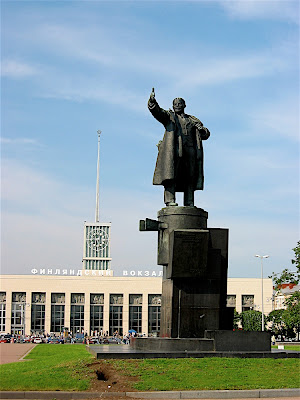
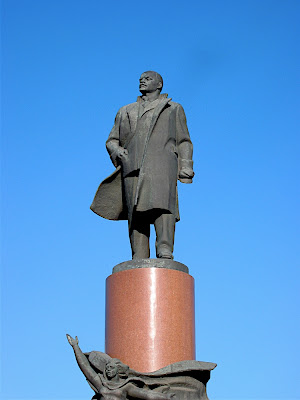
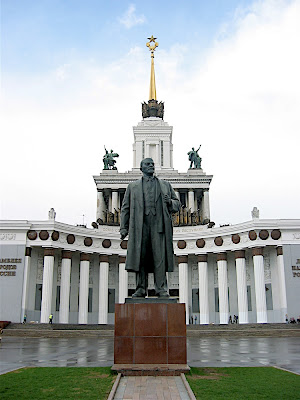
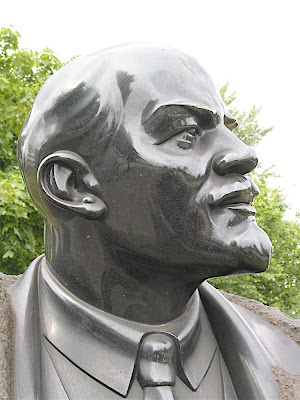
I thought it would be a good idea to sift through 7 years-worth of photos I've taken in Russia and her neighbors and put up an album of some of the best Lenin statues I've photographed. Some of the photos pre-date digital cameras and are a little old/grainy looking, but you get the picture (pun intended?) So here they are...

Finland Station, St. Petersburg:


From this angle, Lenin gives you a thumbs-up: "Hey, isn't revolution GREAT?!!"


Lenin with entourage at Oktyabrskaya Square, Moscow:


Lenin guarding the grounds at VDNKh:


He looks lost in thought. Probably thinking about getting a tasty shaurma from one of the nearby vendors:


Lenin at Sergiev Pasad, paradoxically former seat of the Russian Orthodox Church:


This Lenin stood next to the old Gorbushka, back when it was a sprawling outdoor bazaar. Someone has spray painted "John Lennon" on the base. I've never been able to find this Lenin again, though it probably doesn't help that I've never tried:


Inside the Central Armed Forces Museum in Moscow. As this one is marble, it would be VERY expensive to ship home, I think:


At the outdoor sculplture park next to the New Tretyakov Gallery in Moscow:


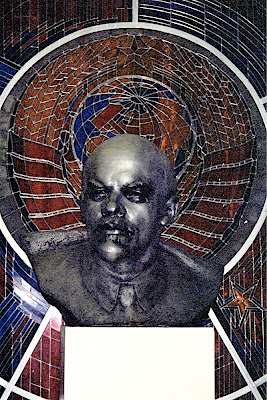
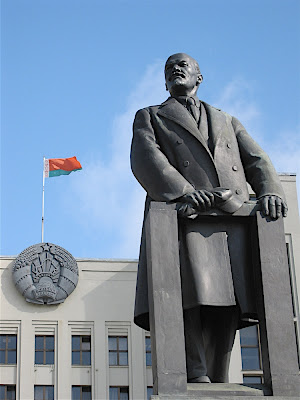
Inside the WWII museum in Minsk:


Also in Minsk:


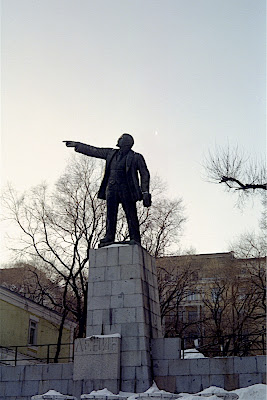
Lenin pointing at Japan from Vladivostok: "Hey! Does that sushi stuff come with mayonnaise?"


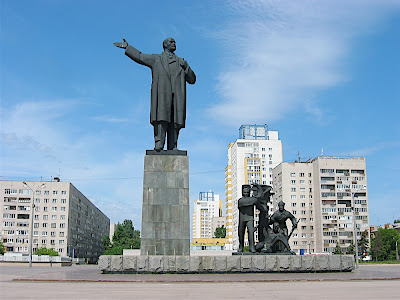
In Volgograd (Stalingrad), Lenin says, "See how nice it is now that we've rebuilt our city?"


The largest bust of Lenin in the world, located in Ulan Ude. I'll confess that this is not my picture. When I was there, it was the middle of the night, it was December, I was sick, and only halfway through my trip on the Trans-Siberian. Needless to say, my own photos didn't turn out very good...


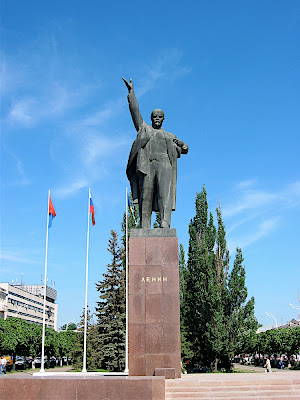
Tambov: Reverend Lenin says, "Can I get an AMEN!"


In Lipetsk, Comrade Lenin doesn't say much. There's hardly any traffic through Lenin Square (recently renamed Cathedral Square because there's a, um, cathedral there). I think he gets lonely.


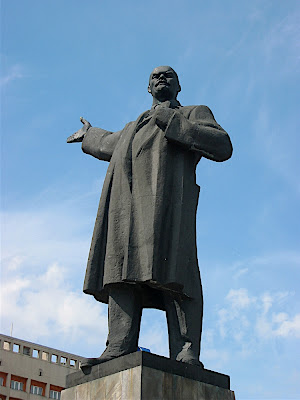
In Nizhny Novgorod, Lenin says, "Look at the wonderful shopping mall they've built next to me. Maybe I was wrong about this whole 'capitalism is evil thing...'"


For the most comprehensive archive of Lenin monuments in Russia, the former Soviet Union, and around the world, take a look at monulent.ru (in Russian), which has Lenin monuments organized by city. Bet you never knew there were so many!

07 July 2007

Petersburg White Nights

Here's a few more pictures from my recent trip to St. Petersburg. These were taken between 11:00 pm and 1:00 am. For someone who grew up in a place where 9:00 is the latest the sun ever sets in the summer, seeing it still light out at midnight is a bizarre experience.

The event I photographed was a concert and outdoor party thrown for the city's high school graduates, who had graduated that day. As you can see from the photos, there were hordes of kids everywhere. Nevsky Prospect was closed from Gostiniy Dvor all the way down to the river, and people were constantly streaming towards the Winter Palace.

I finally bailed at 1:00, partly because I was tired and partcly because it looked like things could easily get out of hand. People were starting to get drunk, rowdy, and pushy, and there were a few moments where someone smaller than I would have had a hard time holding their own against the pulsing crowd.

As I walked back up Nevsky Prospect, the masses continued to flow toward the concert. The street was full of broken glass - as people finished their beers, they would set the bottle on the side of the road. Sooner or later someone would trip over it or deliberately kick it and it would shatter on the pavement. Some of the ornamental iron bollards along Nevsky were ripped out of their foundations, often prying up the pavement stones with them.

To the credit of the St. Petersburg municipal services, by 9:00 the next morning the entire length of the street was spotless - all the glass had been removed and all the bollards and chains had been restored to their original positions (though some were tilting a bit precariously).

In any case, that's enough from me. Here are the pictures:


Guest appearance by St. Petersburg governor (and potential Putin dark-horse successor?) Valentina Matvienko:


This is my favorite photo: two lines (there's another one on the right that's not pictured) of OMON officers guarding..... an extension cord.


03 July 2007

Soviet Jokes

In looking for the Lenin triple-wide joke, I came across the following site that is loaded with tons of classic Soviet-era jokes (translated into English), organized by theme. This should keep you all busy (and laughing) for at least a few days...

Laughing Under the Covers


Enjoy!

(PS - the above cartoon is the Pulizer-prize winning work of Jim Borgman...)

Moscow Through Her Eyes

The Mrs. arrives in Moscow tomorrow. After not having seen her for several months now, I'm nearly going insane with anticipation, but luckily I have some pickles and beet salad to comfort me for the next few hours.

Though this is my fifth stint in Russia, this will be her first time over here. I'll confess, while Russia has always been a major part of my life, it's been a surprisingly small part of our relationship. While there was less of a boundary while we were dating in college, now Russia tends to get filed under "work," and is thus not something we spend a lot of time discussing at home in the evenings. After all, we have other mutual interests and hobbies, and we each have our own individual interests. Russia happens to be one of mine, in addition to being my career.

I also think that my fascination (bordering on obsession) with Russia has always seemed to her as one of my eccentricities, something she doesn't question but is patiently tolerant of even if she doesn't understand it. When we first met there were two Lenins, and I'm sure they raised an eyebrow. By the time we got married, there were 14, and by then they had just become part of the scenery. Now that there are 36 Lenins, I'm not sure what her reaction will be. Actually, I do know: she'll laugh at them (or me?), shake her head a few times, and then propose that we rearrange the Lenins to act out a fighting scene or something. "But they're all friends!" I protested the last time she suggested this...

Needless to say, I'm looking forward to seeing her in Russia. And I don't just mean seeing her, I mean seeing her experience Russia. I want to see how she reacts to the "other woman" in my life (Mother Russia), the woman who has kept us apart for the last several months and made me smell perpetually of garlic. I want to see what Russia looks like through my best friend's eyes since I know it will look entirely different than how I see it.

To be honest, I secretly want her to fall in love with Russia too. Maybe not as head-over-heels as I did (although I won't protest if she wants to start her own Soviet statuary collection), but enough so that it's not so foreign to her anymore. It reminds me of the Soviet-era joke stating that newlyweds needed a triple-wide bed because "Lenin is always with us." In our case, Russia is always with us, and while the Mrs. laid down the law when we moved in together ("No Lenins in the bedroom" were her exact words), I'm hoping that Russia will become a bigger part of our lives together.

And I suppose what I'm really hoping for is that some of my "eccentricities" will be explained when she sees the place that created them...

So, I hope you'll forgive me if I'm lax about posting during the next couple of weeks, as we'll be wandering all over Moscow, St. Petersburg, and possibly even Ulyanovsk (birthplace of Lenin and home to the Lenin memorial museum and complex!!!) discovering ourselves and the mysterious woman called "Rossiya."